
Does genre still matter?
What teaching film noir, westerns, and rom-coms has revealed about how we watch movies now

I realize that this newsletter has been the one that’s fallen through the cracks and been the “forgotten one” relative to my work on music or on golf and baseball (sports mentioned in The Great Gatsby, notably). But my forays into cinema continue on, mainly at my job (which I’ve also turned into its own newsletter and thus will be cross-posting this).
I’ve alluded to how in my “real” life I’m a high school English teacher, and one of the classes I teach is a Film as Literature course. One version of that class focuses on Film Genres. We watch films in the major genres in film and think about what define them (what the conventions are) and move into what it means that those specific conventions exist.
The first unit in that class, in my conception of things, has to be on film noir because that’s the most “talked about” genre and provides us with the most fodder for discussion and writing. I feel like there’s been so much discourse and conversation about what exactly film noir is, what makes it up, that using it as a kind of baseline or test case for how we talk about all genres is a smart move.
What’s been more interesting to me are the other genres that have followed in our class—the western and the romantic comedy. As part of this unit, we’ve watched Stagecoach, The Searchers, The Man Who Shot Liberty Valance, and High Noon for the Western before students will write their essay for this unit defining and analyzing this genre before then considering how a film (Star Wars: A New Hope) draws on the conventions of the Western but moving it into a different context. The romantic comedy work considers some films of the classic Hollywood era (It Happened One Night, The Philadelphia Story, and Sullivan’s Travels) before wrapping up with a more contemporary example, Moonstruck. We consider the seminal, foundational films regarding what a given genre is before thinking about a film that came later and either put the genre into a different context or brought into the contemporary world.
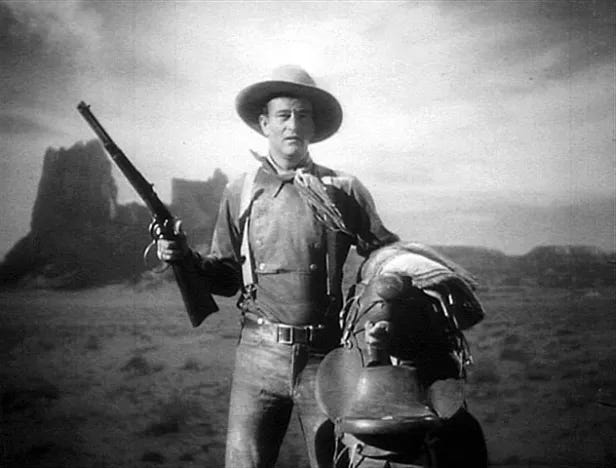
As we’ve been going through and watching these films, I found myself thinking about and appreciating the genres much more while also reckoning with how they’ve become something of an afterthought in our collective movie-going minds. There’s been a lot of “the romantic comedy as we knew it is dead” discourse—has it moved to TV? What do we do with Materialists? Watching those classic Westerns though and I could sense how foreign all of this must’ve felt to my students (even though Westerns do exist and are still being made—Deadwood, The Power of the Dog). But before we’d started, few of my students had thought about westerns and barely any had watched or thought about the romantic comedy. These felt so foreign and strange to them in a way that was at least a little surprising (especially regarding the romantic comedy).
I don’t really know if I have a conclusion or takeaway from all this. I guess I’m just wondering aloud if these genres have any relevance and thus are worth spending the time thinking about. I certainly think there are things to be learned or that can resonate even if we’re living in a different world than that of the western, for example. I don’t think it’s about that. It felt important when I was coming of age and starting to watch film closely to know about westerns even if the old west didn’t seem particularly “relevant” to my life. But I’m wondering if now, to be a savvy film watcher, do you need to have some idea of who John Wayne or Gary Cooper or John Ford is anymore? I would argue yes, but maybe that’s not the reality and thus spending time coming to understand these genres is just a waste or a meaningless exercise.
I see a connection with the struggles students have in learning the concepts of proper grammar. Students can write—not always on the right subject or doing the right work, but they can string the words together—but there’s a block about learning why things are structured as they are. It’s not because they don’t understand the concepts in some essential way, but those rules and forms and structures are somehow out of their grasp.
Now, thinking about those same students as film viewers with their minds expanding, watching more film, but they don’t feel compelled to grasp or think about those formal rules and conventions. How do we change that? How do we instill in them a knowledge about the importance of those forms and constructions? Just as to be the best writer possible you really need to grasp the rules of grammar, if you want to be a truly savvy film viewer knowing the grammar of film (as established through these genres) seems to be of vital importance.
This is really interesting Thomas. As someone who retired from teaching college film courses a year ago, I feel what you are experiencing. I was educated to believe that genres were important building blocks of the film landscape. The problem is that most students today have no frame of reference for what a classic western or romantic comedy is. Films are often a hybrid of multiple genres. The question is whether you believe students in your course need to know how and where their films originated. I think for those in a history of film course, they should. I don't know about film as literature students. I've found it is just as important for them to understand how to read a film regardless of genre. As such, toward the end of my teaching career I maybe spent a week on genres, focusing more on themes, symbolism, art direction, cinematography, editing, etc. But then, maybe you ARE giving them what they need by diving into genres. Only you know if it's working.