
We Didn't Need Dialogue
Watching and enjoying a couple of major works of the silent film era.

In an effort to truly grasp the entirety of cinema history, I've been going back and watching some of the great silent films.
The first one I selected was clearly geared around the Halloween holiday--1925's The Phantom of the Opera starring Lon Chaney and produced by Carl Laemmle. Thanks to the Andrew Lloyd Webber musical, the narrative of the Phantom of the Opera has become one of those things that everyone knows and thus the narrative of the story is quite familiar. Lon Chaney's transformation into the deformed, mysterious, monstrous Erik is quite remarkable. He certainly was worthy of his nickname, "The Man of a Thousand Faces."
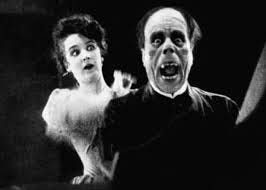
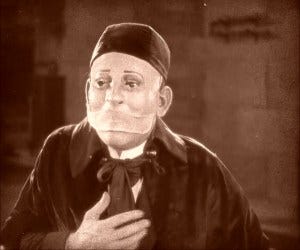
It would certainly be remarkable in our time, so doing that in the 1920s is even more striking. Rather than being this quasi-romantic figure, you do get this sense of the horror associated with him and that he's a part of that Universal collection of monsters. The most distracting part of the film was the mask that Erik wears when he first sees Christine. It's more an issue of how Erik's ailments were rendered in this film and that it extends to the mouth (and thus it needs to be covered in some way, in this instance what seems like a piece of fabric).
The other film I watched is Sherlock Jr. directed by and starring Buster Keaton. It's my first Buster Keaton film (most of my experience with silent film has been with Charlie Chaplin and a little Fritz Lang and Dziga Vertov. Keaton's distinctive approach to comedy and performance is quite notable and does seem different from that of, say, Chaplin (which I might not have grasped all that long ago). The grandiosity of Keaton's physical comedy certainly stands out as does his "stone face" expression, standout out in contrast to Chaplin's extremely expressive face.
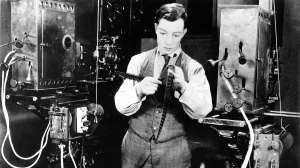
I haven't really dipped into the films of Harold Lloyd, the other great silent film star, but I'm planning on doing that soon. The stunt work and Keaton's physical comedy are both quite notable in Sherlock Jr. This chase scene is particularly striking, and some of the stunts and action stand out today.
There's also an interesting, meta-fictional moment in the film, which perhaps establishes Hollywood's long-running fascination with itself through movies about movies. Keaton plays someone who works at a movie theater and, during a daydream, imagines himself in the world of the film that's screening at his job (playing the titular Sherlock Jr.) and solving a mystery that very much mirrors the strife he is experiencing in his own life. As Dwight Macdonald wrote:
He falls asleep in the projection booth, dreaming about his girl and his frustrated love. His doppelganger extracts itself from his sleeping body … and walks down the aisle of the darkened theatre to climb up on the stage and into the society-crook melodrama being projected on the screen … There's no explanation for this or any other lapsus naturalis in this 1924 film which makes later efforts by Dalí, Buñuel and Cocteau look pedestrian and a bit timid. They felt obliged to clarify matters by a symbolistic apparatus. Keaton never rose—or sunk—to that.
That magical quality--some have associated it with surrealism--gives Sherlock Jr. a magical quality that makes it quite distinctive. Woody Allen would draw on the film in his 1985 film, The Purple Rose of Cairo.
As I've said, my journey into silent film will likely continue with some of the works of Harold Lloyd, thus providing me with a sense of the three major silent film stars (Keaton, Chaplin, and Lloyd). But it's quite remarkable to watch these silent films, almost one hundred years removed from their release, and to continue to find them so engrossing.