
"Secret honor, public shame"

I have a hard time assessing the place of 1984's Secret Honor has amongst the oeuvre of Robert Altman. It's an interesting film, notable in that it only features one part and the set is essentially that of a play. While perhaps not as definitive as his 1970's work, it is a film I've seen talked about and thus wanted to see.
The synopsis of the film is:
A fictionalized former President Richard M. Nixon offers a solitary, stream-of-consciousness reflection on his life and political career - and the "true" reasons for the Watergate scandal and his resignation.
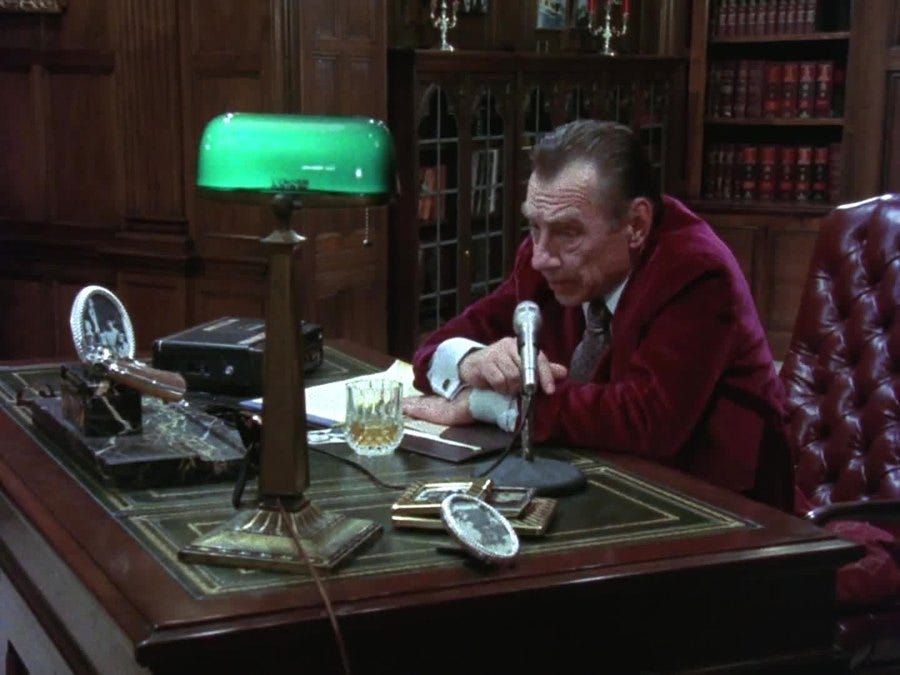
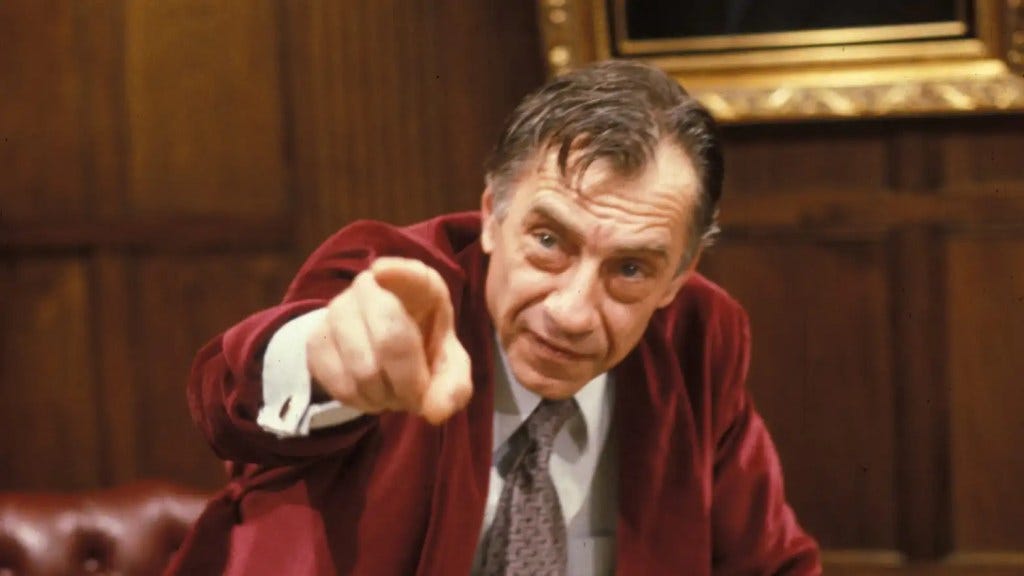
Philip Baker Hall, who I will always see at the library cop Bookman on Seinfeld and Floyd Gondolli in Boogie Nights, is the lone actor, performing as this fictionalized version of Richard Nixon. When I think about the actors who could potentially pull off this feat, being able to be the lone figure at the center of the screen for an entire film, I don't know if I could have thought Hall was that person. Yet his performance as Nixon is powerful. He captures the seeming contradictions of Nixon, leaving us at times feeling sympathetic for him while then eliciting disgust.
Michael Wilmington's opening paragraph for this Criterion Collection piece on the film sums it all up:
Nixon as Hamlet, Nixon as Lear, Nixon as Blanche DuBois, Nixon as Krapp—clutching every last tape to his breast with the wild fury and despair of a man on the precipice . . . Nixon in his study, poring over his past, gazing at his own multiplied monochrome image in a bank of TV monitors . . . Nixon fulminating, raging, screaming at a portrait of the “whoremaster” Kissinger, dictating with somber resignation his own defense against history and disgrace into a tape recorder . . . Nixon drinking, defiant, dissolving into tears, Nixon Agonistes, Nixon bellowing every expletive you could imagine, then sinking to the floor in exhaustion . . . Nixon with the gun to his temple, the final gambol and endgame of the Old Prankster, Tricky Dick in the mirrored halls of memory and conscience.
Though Hall isn't giving us an impersonation of Nixon (like we see in some other, later films depicting historical figures), he is able to capture and manifest the essence of Nixon. The jowliness, the feeling of inferiority, the scheming, the sentimentality, the vengeful, Hall renders it all on screen. I look at the nominations for the 57th Academy Awards (which honored the films of 1984) and I cannot fathom that Hall would not be at least nominated. Yes, it's hard to argue that anyone was beating F. Murray Abraham as Salieri in Amadeus, but... Jeff Bridges in Starman getting nominated and not Hall is a bit of a shock.
It, almost certainly, has to do with Altman and his standing that Secret Honor would be "perhaps the least seen and appreciated of all the great American films of the 1980s," to again quote from that Criterion essay. Altman was certainly no friend of Nixon and thus this project, which would explore Nixon as this (even more) paranoid and broken man would be of interest to him. But I like this assertion made by Wilmington:
He’s exploring himself as well. More than a few critics have pointed up similarities between this Nixon—isolated, cut off, ruminating on past glories, playing with video cameras, manipulating his image—and the “exiled” Altman of 1983, at the recognized low point of his career.
In a figure whom he seemed to detest, perhaps Altman was able to engage with himself.
Though Secret Honor is set up much like a staged play put to film, I don't think we can dismiss Altman and his team's vision with this film and that it is a film fitting within Altman's whole corpus.. Though the camera work is subtle, limited by the single location, its movement and positioning does contribute to the viewer feeling the paranoia and claustrophobia that Nixon feels as well. It's an upsetting film, and it's meant to be.
You also get that sense of critique and satire that pervades so much of Altman's other films in Secret Honor. It is clearly satirizing Nixon himself, but there's also this critique of institutional power ("The Committee of 100" and the "Bohemian Grove"). While there isn't dialogue in the film (since it's just one character), you don't get the typical overlapping Altman dialogue. But I think of the halting way Hall speaks as Nixon, the sudden starts and stops and digressions, and perhaps see it as being that form rendered by just one figure.
Secret Honor is a unique film within Robert Altman's filmography, yet doesn't seem to be one we should overlook. If you are curious about some of those divergent aspects of his work, or you just want to see an amazing, singular acting performance from Philip Baker Hall, you should give it a watch.