
"You're full of ifs"
Sam Peckinpah's 1972 film The Getaway gives us a chance to appreciate Steve McQueen's star persona as well as the magnetism of Ali McGraw

I’ve been on a bit of a Steve McQueen kick of late, which included a re-watching of Bullitt, the famous detective film set in by beloved San Francisco and featuring some of the greatest car chase work in cinema history. But that wasn’t the only film starring McQueen I’ve watched recently. There’s also the film whose production led to Ali McGraw leaving her husband, producer Robert Evans, to marry her co-star Steve McQueen, The Getaway.
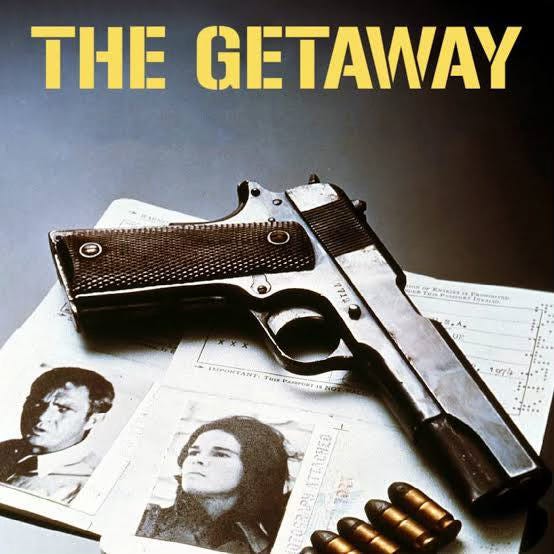
Directed by Sam Peckinpah with a script written by Walter Hill based on Jim Thompson’s novel, the film tells the story of Doc McCoy (McQueen) and his wife, Carol (McGraw) who go on the run following a bank robbery in Texas. It’s only the second film directed by Peckinpah I’ve seen (I watched The Wild Bunch a while ago, but probably need to revisit it sooner rather than later), but I picked up on a lot of the stylistic hallmarks; namely, the slow motion, the depiction of violence and action, and this life outside the boundaries of normal, law-abiding society. The Getaway feature some strong set-pieces that allow Peckinpah to show off a bit. There’s a great, highly stylized shootout in an El Paso hotel near the end of the film that in a strange way makes me think of No Country For Old Men. There’s also a great bit of conning and chasing involving a train station too.
It’s an interesting McQueen performance that seems so different than the aforementioned Bullitt or The Great Escape. Though Doc is cool, he’s not cool in the same way Bullitt is (or even Hilts in The Great Escape). But McQueen’s magnetism and charisma is in abundance and you can’t help but be drawn to him. It’s the first thing I’ve ever watched starring McGraw (I’m not really one for Love Story). Besides her stunning, obvious beauty, she does have this… live wire quality. The chemistry between McQueen and McGraw is palpable and you can see them, essentially, falling in love and you can understand why.
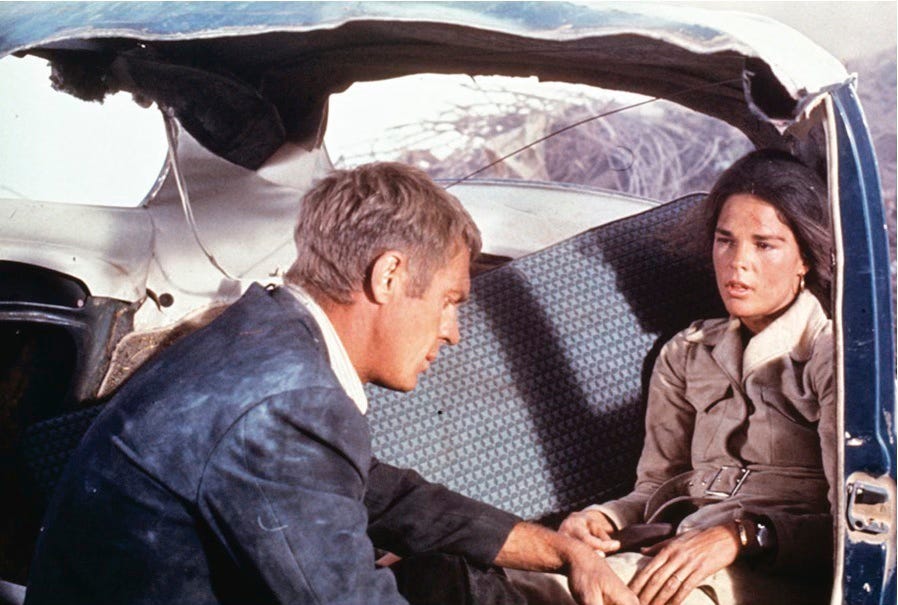
Tarantino devoted a chapter to The Getaway in Cinema Speculation (I promise I’ll cover films that weren’t discussed in that book at some point), but I couldn’t help but remember what Tarantino wrote about Al Lettieri who plays Rudy, who was part of the bank robbery with Doc before turning on them. Though he’s playing a villainous character, it feels so over the top it’s distracting. You’ve also got Ben Johnson, figure from John Ford’s films, playing Benyon, the Texan who puts together the bank robbery that goes awry while also facilitating Doc’s release from prison that precipitates the action of the film. But the film is about McQueen and McGraw. It’s their show and their stars burn bright.
I’m not sure what my assessment is of The Getaway. I like McQueen and McGraw a lot, and I do enjoy some of Peckinpah’s flourishes and interests. But there’s so much about the film that’s strange, and not in a good way. There’s peculiar stuff dealing with sexuality going on (Carol and Benyon, Rudy and Fran Clinton) that seems so dated and regressive now. I also find the moments of humor, of almost a slapstick variety, to be disorienting. Roger Ebert described the film as “a big, glossy, impersonal mechanical toy […] It functions with great efficiency but doesn’t accomplish anything” and I think there’s something to that. I don’t think it’s “big, glossy”-ness or its “great efficiency” should be forgotten. I also think it’s a tremendously important film as a way of understanding McQueen’s star persona. But I also don’t know if it rises to the level of some of the other great McQueen films, nor do I think it’s an equal to some of the other great films produced at the same time.