
"Do you know any of these shows or people I'm talking about"
My takeaways after watching quite a few films directed and/or written by Quentin Tarantino.

I have a complex relationship with Quentin Tarantino. Perhaps because it's too easy/expected that I--straight white guy film lover--would be a fan of his, but I've withheld a little bit. I do have some questions about some of the racial politics of his films, and I can see how his constant cribbing/alluding might rub some people the wrong way and can make his films seem... hollow?
As I've said, Martin Scorsese is my clear, obvious, without a doubt favorite filmmaker. After Scorsese... you've got Bergman, Bresson, John Ford, Billy Wilder, Francis Ford Coppola (by virtue of the Godfather films), Hitchcock, and of the latter day filmmakers Quentin is probably the one that gets included. I can certainly grasp some of those complaints and criticisms, but I've ultimately really come to appreciate his work as a filmmaker and lover of film, putting him into my personal pantheon.
Amongst the many different things I appreciate about Tarantino (his obvious gifts in terms of film and story, his wit), one thing I've realized I really appreciate is his omnivoracious approach to all culture. There's talk about "high" and "low" culture and the mixing of the two, and I think Quentin is quite adept at that. He's just as apt to allude to some piece of world cinema or art as he is an exploitation film or comic book arc. As someone who is a cultural omnivore, I understand that and gravitate towards it.
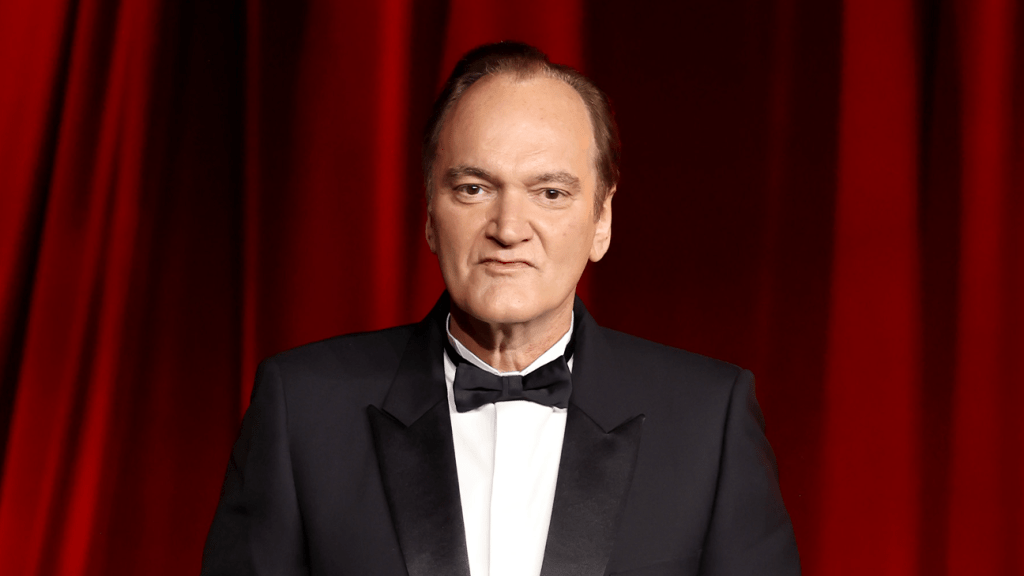
Also, in his book Cinema Speculation, Tarantino talks about how his mom took him to more mature/complicated movies at a young age, showing him things that challenged him when his peers weren't watching those things. That is something that very much lines up with my experience (the story I always tell--my mom had it on file at our local video rental store that I, even though I wasn't 18 yet, could check out R-rated films because I was making my way through the AFI 100 Greatest Films list and wanted to watch The Godfather and films like that).
I've been filling in some of the gaps in my Tarantino study of late, watching the films of his that for one reason or another I hadn't caught up with. Here are some of my reactions to finally watching those films.
The Hateful Eight
After Django Unchained (which I enjoyed, but is near the bottom of my Tarantino film rankings), I wasn't really in the mood for a QT-Western. I also think I was put off by the expansive run-time and didn't know when I could justify committing the time. Thus, The Hateful Eight sat unwatched and unconsidered by me for a lot longer than I would care to mention. However, I finally caught up with it and was quite disappointed I'd waited this long. In the end, I think I prefer Eight to Django when it comes to QT's proper western films.
Beyond the great performances (Kurt Russell [more on him later], Samuel L. Jackson, Jennifer Jason Leigh, Walton Goggins, Michael Madsen, Bruce Dern), the plotting and the way in which the tension is continually raised is remarkable. When we think of westerns, we think of sprawling landscapes., and yet Tarantino has created one that takes place within one location (a snowed-in stagecoach stopover). It's not original to note, but the film draws on John Carpenter's The Thing, which starred Russell.
There are some things that keep it from being at the level of Tarantino's greatest work--I wasn't wild about Tim Roth doing essential a Christoph Waltz impression, some of the elements of race as well as gender (in regard to Jason Leigh's character) leave a funny taste in one's mouth, and the size/length does feel as though it could have been cut down a bit. But I think it's an interesting document of a film that doesn't seem like it would fit within Tarantino's oeuvre and yet it bears his thematic and stylistic hallmarks.
Kill Bill: Volume 2
It perhaps didn't help my experience of Kill Bill: Volume 2 that it's been almost 5 years since I've watched Kill Bill: Volume 1. I would be curious to go see these films in The Whole Bloody Affair single package version because Volume 2 very much didn't feel like (or feel like it should have been ) a whole film unto itself. Volume 1 did feel very much like a complete work that stood on its own, but Volume 2 didn't quite feel that way. There were some real standout parts, namely Beatrix/The Bride's (Uma Thurman) escape while being buried alive by Budd (Michael Madsen) and the fight between Beatrix and Elle (Daryl Hannah).
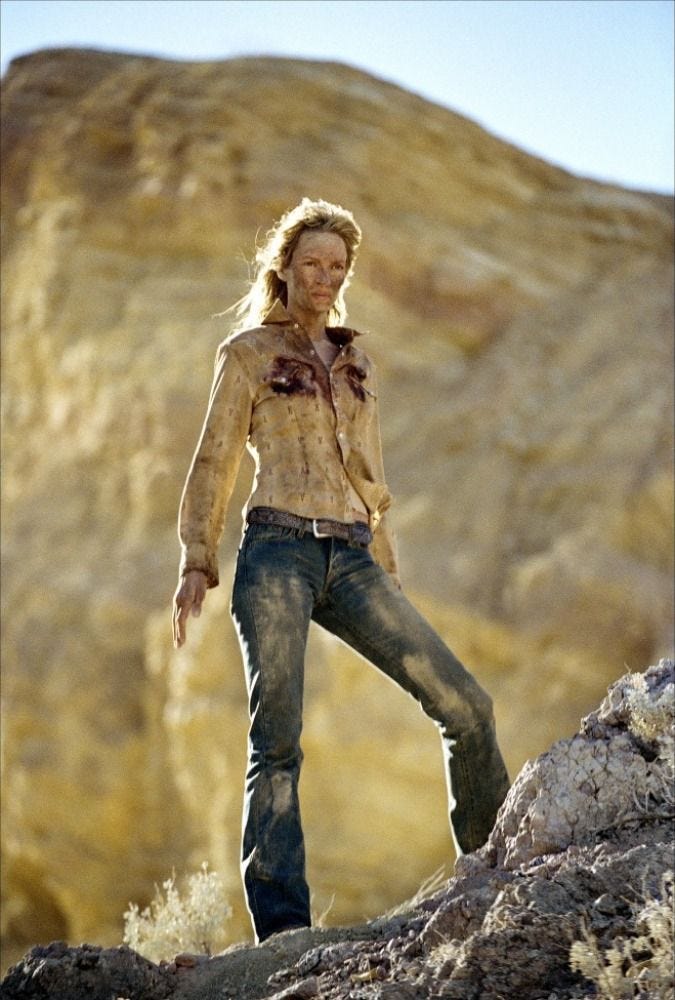
Thurman's performance is certainly great, and the way in which she differentiates between the earlier version of her character (in flashbacks) and who she becomes is very impressive. I also thought David Carridine's casting and use was a nice homage and point of reference. But the final confrontation between Beatrix and Bill (Carridine) feels... not quite right, especially when standing on its own as part of its own volume rather than one whole film.
Death Proof
In a similar vein to the Kill Bill films (which were an homage to martial arts and exploitation films that Tarantino loved), Death Proof really draws on the history of exploitation cinema (more horror/slasher oriented) in his film about Stuntman Mike (played by Kurt Russell) who murders young women with modified cars he describes as "death-proof." Russell has appeared in a few Tarantino films, and I wonder what Tarantino could've done with younger, more proper movie star Russell had he been directing at that time. I could see him using Russell in much the same way he's used Brad Pitt in Inglorious Basterds and Once Upon a Time in Hollywood. Russell is able to be both charming in the ways he naturally is but also menacing and horrific, as befitting this role.
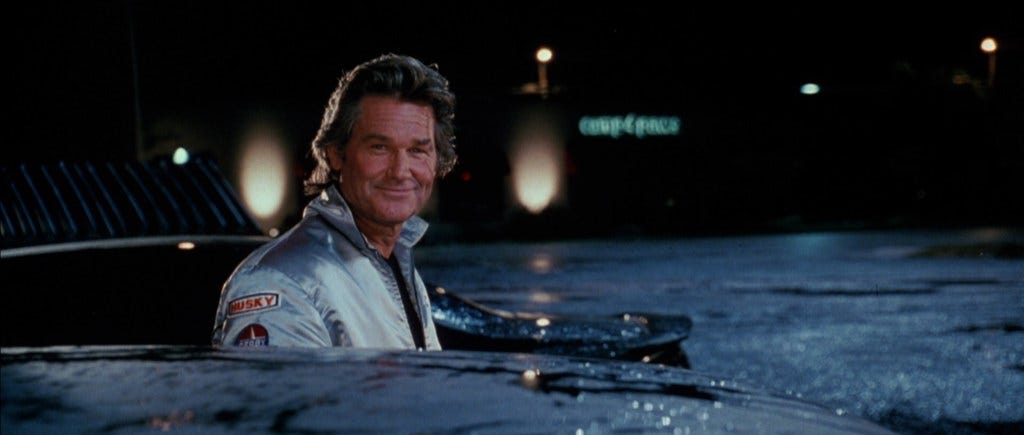
Given that it's so clearly an homage to low budget exploitative cinema, it's hard to read too much into the Death Proof in terms of thematic weight and significance. There is some pretty low-hanging stuff when it comes to gender, sexuality, violence, and repression (particularly filtered through the lens of the cinematic experience). I also think putting Zoe Bell, who was Uma Thurman's stunt double in the Kill Bill films, was a nice touch and made this (to trot out a cliché) a kind of love letter to this kind of stunt work (that would be further explored in Once Upon a Time in Hollywood).
I would also be remiss if I didn't note that the music in Death Proof is outstanding as is the use of Austin in the first segment of the film (Guero's and Texas Chili Parlor are all places I'm familiar with as a former Austin-ite).
True Romance
The outlier in that Tarantino did not direct this film (Tony Scott did), but True Romance is very much a Tarantino film even though it has some of the visual panache associated with Scott. Christian Slater and Patricia Arquette star as Clarence and Alabama, newlyweds (very much in love) making their way across the country looking to make a big score with stolen drugs all while chased by the mafia. The cast includes so many great names: Dennis Hopper, Christopher Walken, Gary Oldman, Saul Rubinek, Bronson Pinchot, James Gandolfini, Brad Pitt (?!?), to name just a few. The whole script, and particularly Clarence, bear the witty, savvy pop culture mentality indicative of Tarantino. There's visually a lot of the Tony Scott hallmarks (if you've seen Top Gun at least, you can pick up on them), but the narrative and the characters... that's all Tarantino. It was, of this batch of four films, the one I regret not seeing sooner. True Romance is both a subversion of a lot of cinematic tropes, but also an affirmation of them and the power of those stories.