
Oppenheimer: "Theory will take you only so far."
Christopher Nolan's hit 2023 biopic centering on the man driving the Manhattan Project.

Another film that I’m embarrassed took me this long to catch up with is Oppenheimer. As I’ve alluded to, my life is not such that I’m overflowing with moments where it’s possible to sit and watch a three-hour film; therefore, it took some time for me to commit to it (and, sadly, I had to break it up over many viewings. But when the alternative is just not watching… I think it’s a sacrifice I can make). Having done so, I can see why it was so popular with both audiences and critics. It is particular interesting as a film that is both cinematic in the sense we all think of but also how it resists that. Though it’s not my favorite Christopher Nolan-directed film, I’d put it in my Top 2 or 3, and I can certainly see why it’s the film that he finally received Academy Award voter recognization from.
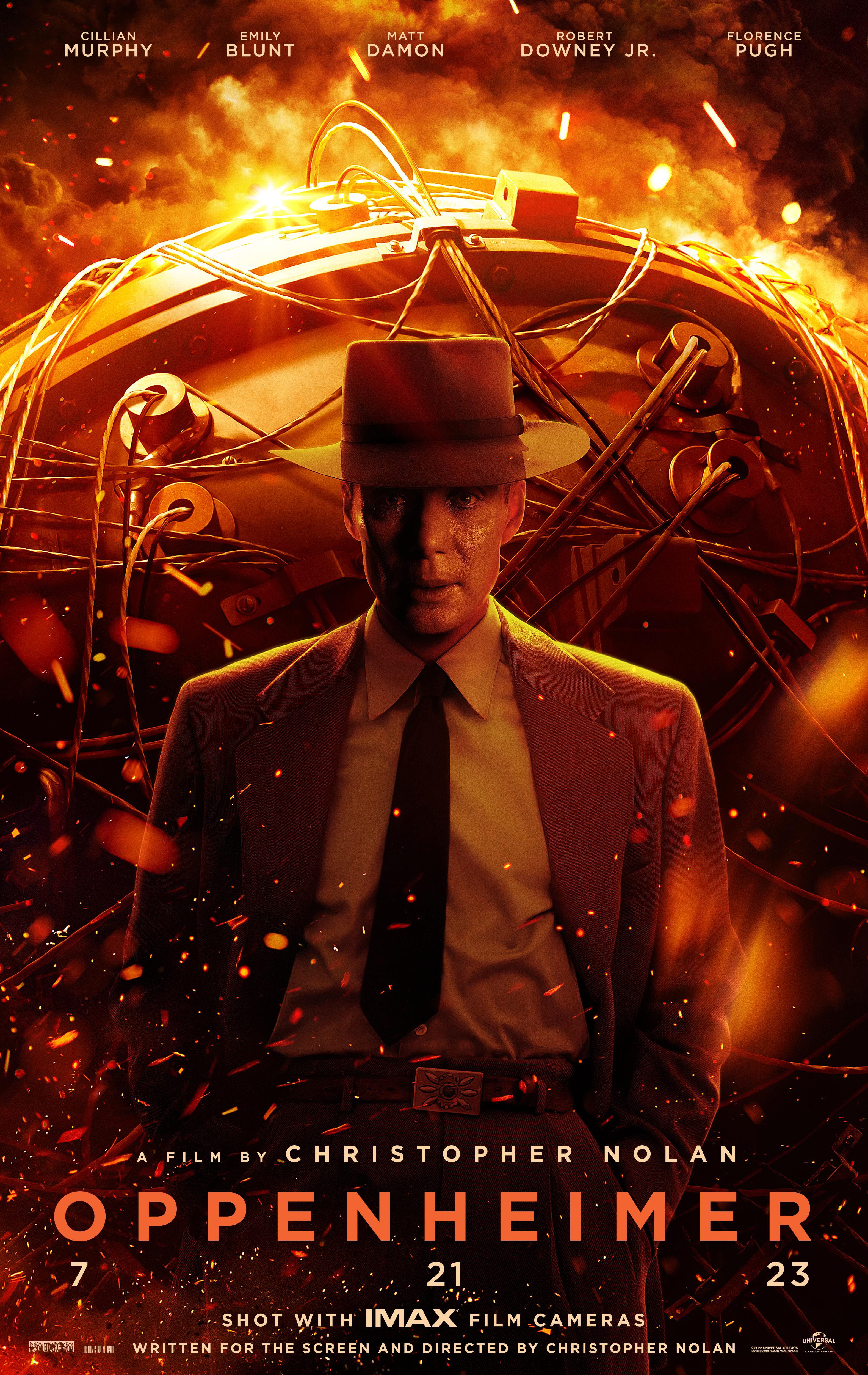
Oppenheimer stars Cillian Murphy as the scientist behind the Manhattan Project. The film also features Robert Downey Jr., Matt Damon, Emily Blunt, and Florence Pugh amongst others. Murphy won the Best Actor Oscar while Downey Jr. won Best Supporting Actor for his portrayal of Lewis Strauss, the chief antagonist to Oppenheimer. Those awards were certainly well deserved as both were excellent in their roles. More on Murphy later, but Downey Jr. was a standout in his first really dramatic role following his time in the MCU (to which he’ll now be returning, since he got that Oscar). Pugh is captivating as Oppenheimer’s paramour while Blunt is a bit hamstrung by a simplistic and reductive portrayal as Oppenheimer’s wife, but that has to do with the characterization rather than the performance. There’s also some great small performances, including Josh Hartnett as Ernest Lawrence, Kenneth Branagh as Niels Bohr, Rami Malek as David Hill, Benny Safdie as Edward Teller, to again name just a few. My favorite was probably Hartnett as Lawrence, if only because of Lawrence’s connections to the University of California at Berkeley. Also, there’s David Krumholtz and Matthew Modine! And Gary Oldman!
I’ll get to talk about the visuals and all of the Nolan flourishes we get, but what’s quite remarkable is that this film sustains both amazing visual work while also having a collection of amazing acting performances by an expansive ensemble cast. But the star really is Murphy, who is able to capture Oppenheimer (or something about him) perfectly in his stoic, removed performance. Seeing Murphy, who in interviews is so warm and gregarious, play this very theoretical and detached man is quite shocking.
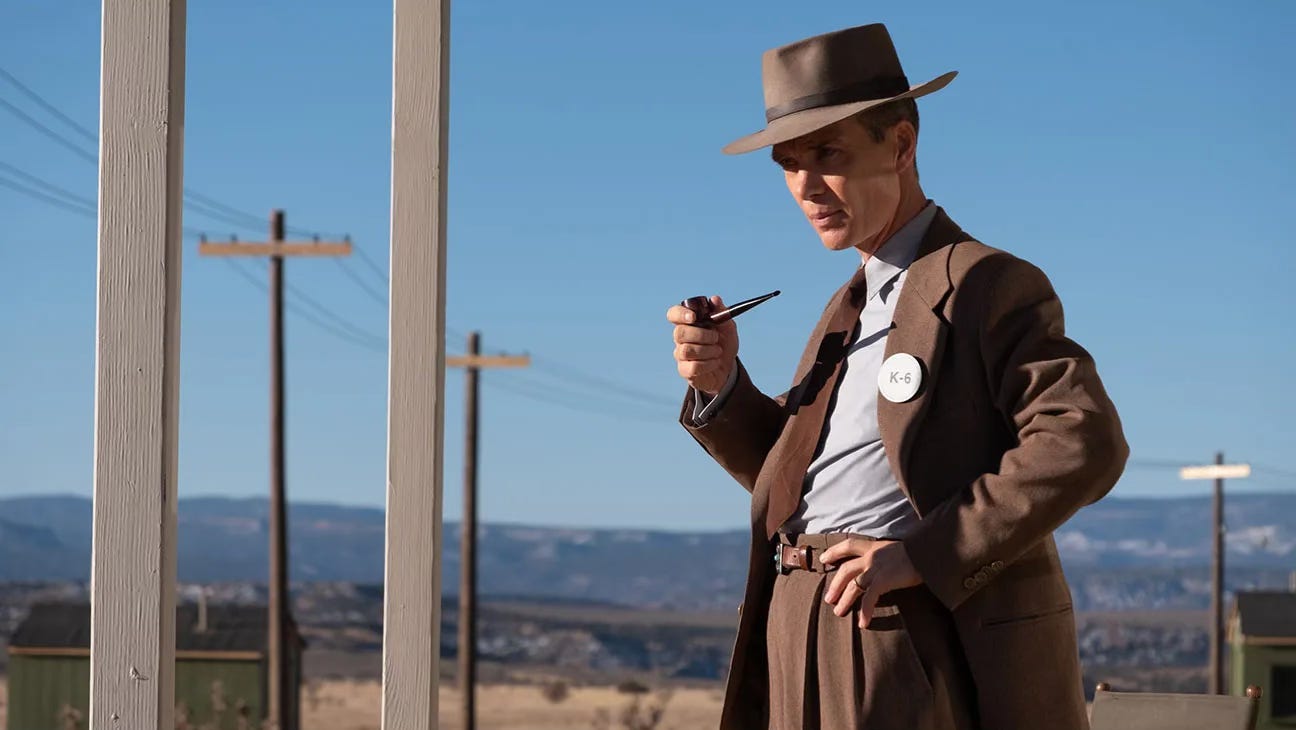
The film focuses on Oppenheimer’s work in Los Alamos to develop the atomic bomb as well as his feelings following the use of that weapon, his 1954 security clearance hearing, and Strauss’ failed conformation hearings to become the Secretary of Commerce under President Eisenhower. It’s not a full biographical rendering of Oppenheimer, but you get to see that most important moment that leads to the development of the atomic bomb as well as the proverbial fallout within Oppenheimer and throughout the United States and the world from its creation and use.
Coming from the director of Inception and Interstellar, it’s not a surprise that some of the visuals of the film are quite amazing. Sadly, I did not see this film in theaters but I can only imagine how awe-inspiring it would be to see this in IMAX, for example. The cinematography by Hoyte van Hoytema, who worked with Nolan on Interstellar and Dunkirk, is distinctive as is the cool color palate seen across just about all of Nolan’s films. Van Hoytema won the Best Cinematography Oscar while Nolan won the Best Director award. There’s also the Nolan-esque flourish of playing with time (moving between the different hearing and conversations through flashbacks) that, yeah, can be a bit disorienting and destabilizing, but is also to be expected in a Nolan film.
The film feels like, understandably so, it’s building towards the Trinity test of the atomic bomb, which is a stunning sequence and up there with the best of Nolan’s filmography (at the same level as the truck chase scene in The Dark Knight). The scene in which Oppenheimer addresses the people in the Los Alamos gym following the use of the weapons on Hiroshima and Nagasaki is also quite remarkable and shocking too and is really an effective counterpoint to that Trinity test scene. This also plays out the central…. not conflict, but tension of the movie and obviously what Oppenheimer himself felt. On the one hand, in the Trinity test, you have the success of this testament to science and creation… and yes, weaponry but in the service of winning a war against the evil of fascism. There is a larger discussion one can have about it, but I’m not equipped to do that.
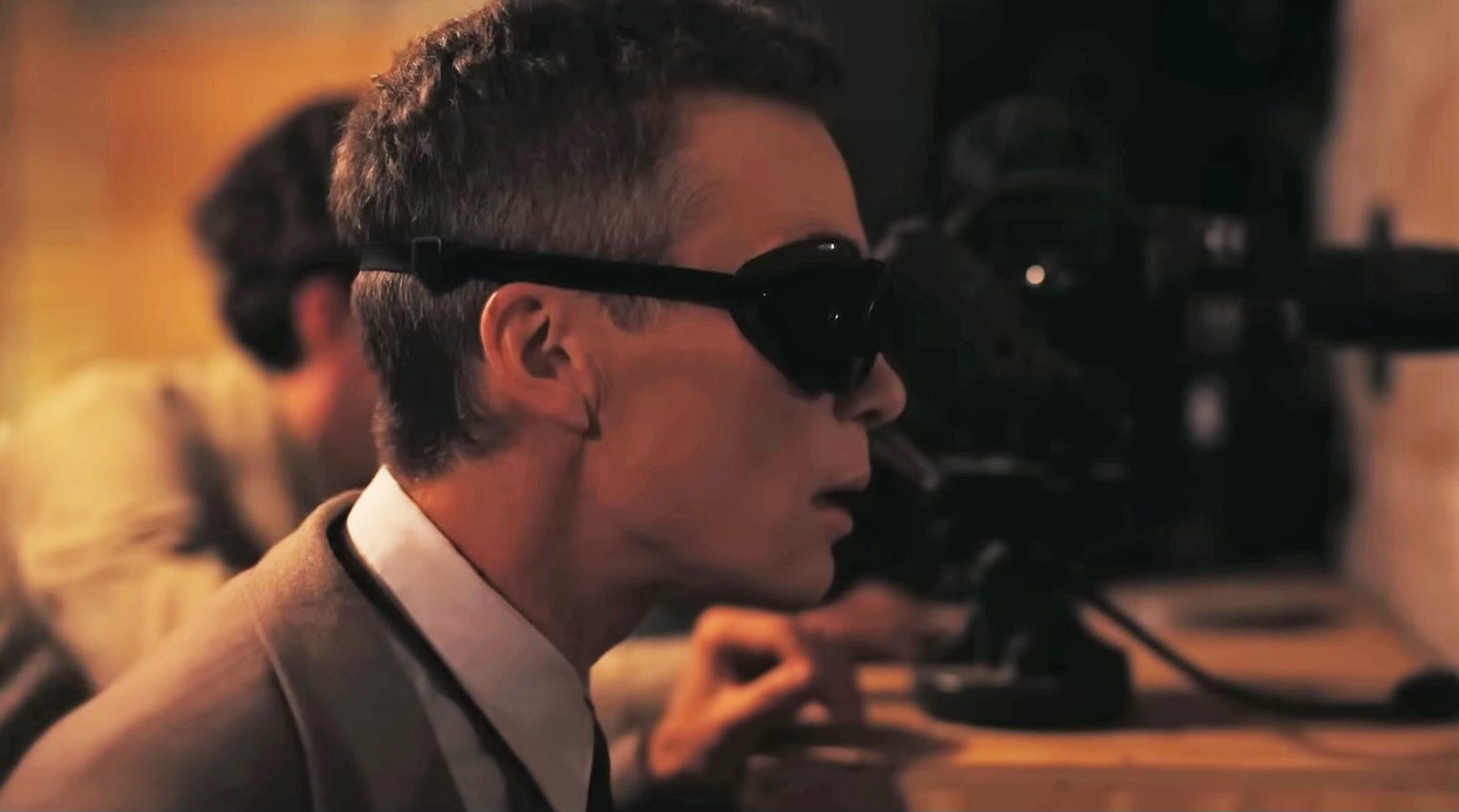
But then that moment of addressing the crowds following the use of the bombs, and you see Oppenheimer really reckoning with the guilt of what he’s wrought. The former is maybe the most traditionally cinematic scene as the building to the big and pivotal moment of the film. But the latter is much stranger, less conventionally cinematic, but plays out the integral anguish and conflict that has been created. There’s also not true resolution, no easy answers given, which is not what you’d expect from a film that had such a broad appeal and yet Nolan challenges us there.
Because I’m not evolved enough in my cinephile status, I always think about Nolan’s Batman films when it comes to his sensibility. However, I do see traces of his Batman films in Oppenheimer in some of the themes and ideas being explored. I’m particularly interested in the notion of escalation, which appears in all those films. There’s also the question of when one feels like they can do something to help win some kind of battle against evil, but also having to consider the cost… I strangely felt like there was a bit of Batman in Oppenheimer, which is kind of amazing. Perhaps it’s the greatest thing we can say about this film and Nolan’s direction of it is that he makes a biopic of a scientist feel as exciting as a super hero movie.
I think it makes sense that Oppenheimer is the film that earned Nolan his Best Director Oscar. It was a cinematic form readily understandable (the biopic of a major figure in American history), but it also included his directorial flourishes and thematic concerns. Yes, Killers of the Flower Moon was probably my favorite or the best film from 2023 (which I will be writing about, one of these days), but it doesn’t feel like such an injustice that Oppenheimer trumped it at the Oscars as it did when Wolf of Wall Street and even The Irishman was shut out. It’s a testament to Nolan’s ability to engage with big themes and ideas—America, guilt, morality, violence—that makes me even more excited to see what he does with his adaptation of The Odyssey. Oppenheimer feels like the culmination of something for Nolan, giving him a level of success he hadn’t reached, and perhaps sets him up to go even further as his career continues.