
"I don't believe in surrenders. Nope, I've still got my saber"
A couple of films, highlighted by Tarantino, that engage with the themes and structures of John Ford's The Searchers

I’ve recently taken a journey into a couple of films beloved by Quentin Tarantino, whom I wrote about here. These two films are... exploitation (or exploitation adjacent) films and both written by Paul Schrader, famed screenwriter of Martin Scorsese’s Taxi Driver. What I think is most interesting is to think about the ways in which both these films, much like Taxi Driver itself, draws on the forms and themes of John Ford’s classic film The Searchers and places that narrative into the contemporary world. Schrader uses these more popular and exploitative cinematic forms to sneak in questions about morality in America, particularly post-Vietnam America.
Rolling Thunder
Reading Tarantino’s excellent book Cinema Speculation, his chapter on Rolling Thunder was maybe the most intriguing to me. It’s a film that I hadn’t heard much about until Tarantino brought it to my attention. The film, which is part of what is referred to as the “vetsploitation” genre (where an exploitation film centers on a veteran as its main character), is directed by John Flynn based off a script by Schrader and Heywood Gould. William Devane plays the veteran, Charles Rane, who seeks revenge on the criminals who murder his family upon his return to America following a stay as a prisoner of war. The film also features a young Tommy Lee Jones as one of Rane’s fellow returning POWs.
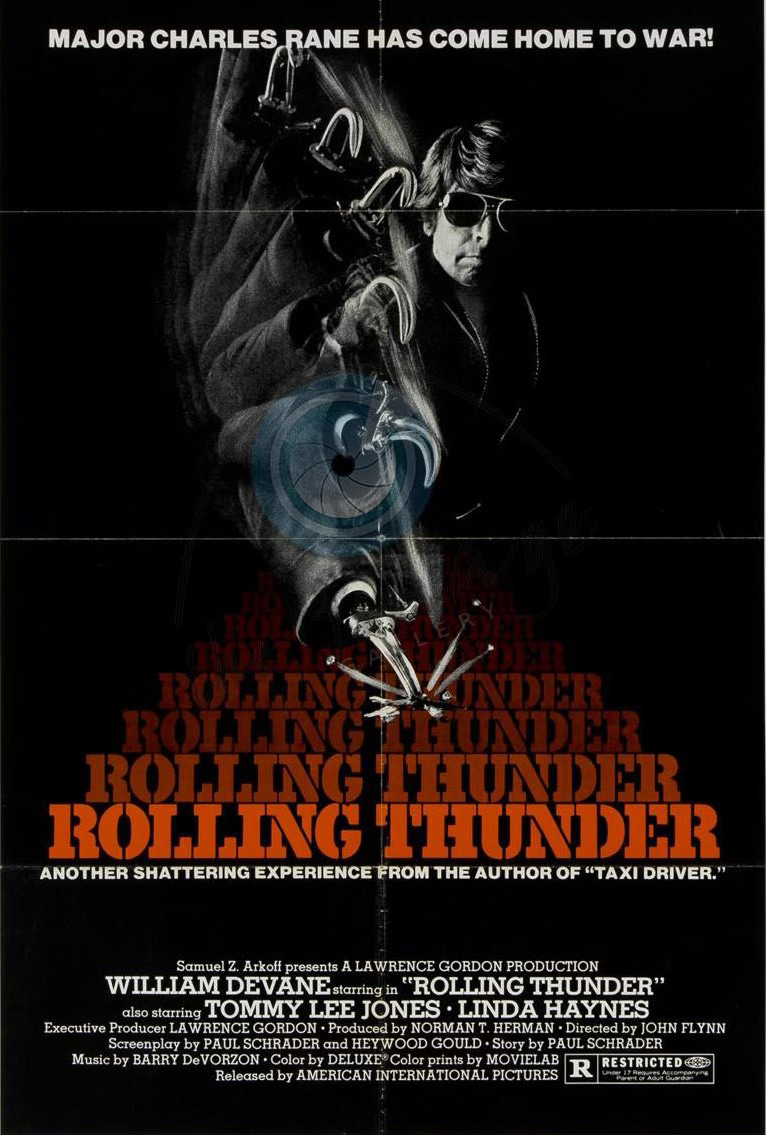
The film has that rickety, exploitation film feel to it. Devane plays Rane as being almost catatonic and non-verbal, which reflects the inability to reacclimatize to the civilian world following the war. It is a bit of a shock to the nervous system to see such a young Tommy Lee Jones, but he’s perfect as one of Rane’s men who ends up supporting him in his quest for some kind of retribution for the violence he’s suffered.
You can certainly see elements of Taxi Driver present in Rolling Thunder: the returning veteran and the sense of displacement, the violent climax that takes place in a brothel. There are certainly differences: namely, Travis Bickle is clearly mentally unstable while Charles Rane is not, or at least not in the same way. Also, Rane’s vendetta is very much a personal one (these are people who hurt him—bad people but specifically bad ones who got to him) while Travis’ quest for retribution is more… philosophical.
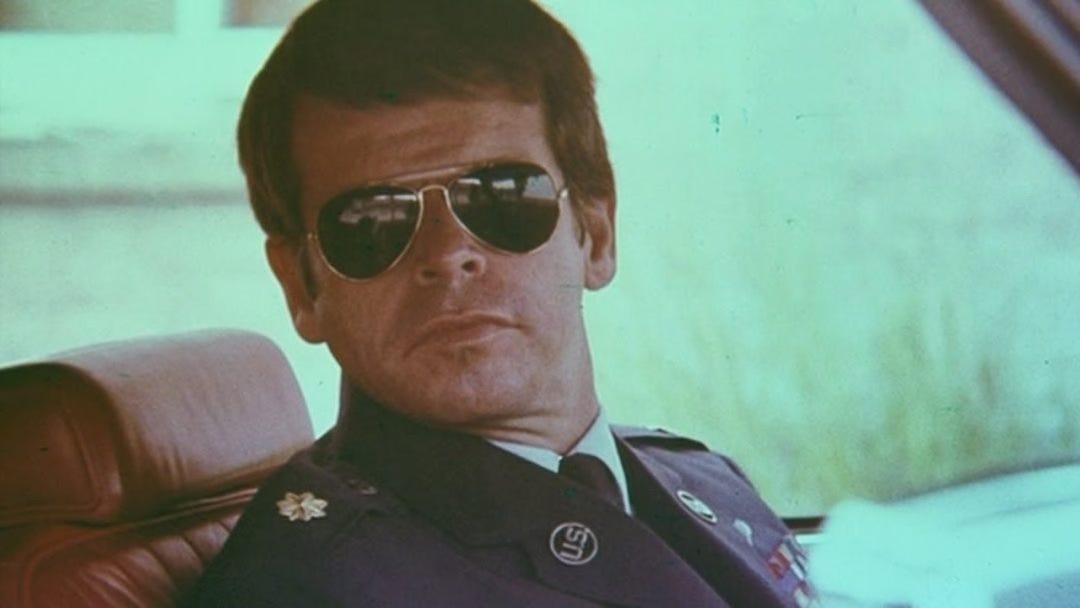
What was interesting to revisit in Tarantino’s Cinema Speculation was the way in which Tarantino tied the film to The Searchers in ways I didn’t totally realize. Tarantino highlights the ways in which both feature narratives of men returning home from wars in which they lost (Vietnam for Rane, the Civil War for Wayne’s Ethan Edwards) and struggling to find a place within the world before heading out into a kind of unknown wilderness. While Rolling Thunder was a fun film in that late 70’s action film mode, reading Tarantino’s thoughts on the film and thinking about those connections to The Searchers made it a bit more interesting.
Hardcore
The second film, Hardcore, is not only written by Schrader, but also directed by him. There’s also a chapter in Cinema Speculation devoted to that film, just as there was with Rolling Thunder. The film stars George C. Scott as Jake Van Dorn, a conservative Dutch Calvinist from Grand Rapids, MI (very much the milieu Schrader grew up in and rejected to become a filmmaker) whose daughter goes missing during a mission trip to California and becomes involved in the world of pornography. The film also stars Peter Boyle (strengthening its connection to Taxi Driver) and Season Hubley.
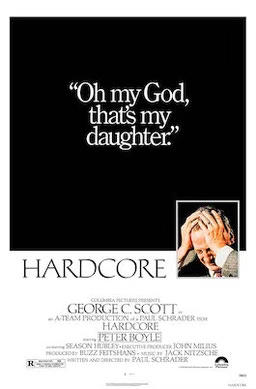
While Rolling Thunder is very clearly in that exploitation/grindhouse milieu, Hardcore is interesting in that is has one foot in that world and another in something closer to Taxi Driver. The tagline and the poster emphasizes the tawdriness and sleaze and degradation, but that’s not all there is relative to what another filmmaker might do with this kind of story. Scott is an interesting choice in the lead role—he does evince that kind of stolid midwestern bedrock morality, but he also feels so much of a different era and world that it seems a bit out of place. I don’t know who would’ve been a better choice (Warren Beatty was initially attached, but I don’t know if that would’ve been any better).
There are certainly the elements of connection with Taxi Driver with a character going into the world of sex work (pornography rather than prostitution) to rescue someone. The way in which Los Angeles is used is like New York in Taxi Driver, in some ways the West coast equivalent. There’s also a reference to a Mrs. Steensma as part of the Grand Rapids crew, with Steensma being Iris’ last name in Taxi Driver.

But its connections to Taxi Driver are not as great as the ties to The Searchers itself. The notion of the man out of place with Scott’s man of Midwestern conservative values so outside the world of progressive sexual attitudes depicted in the film. He’s entering into a land he deems immoral or unjust, just as Ethan Edwards does into the terrain of the Comanche. You also have the private investigator Mast (played by Boyle) frequently referring to Van Dorn as “pilgrim.” The ending, when Jake does find his daughter, also clearly draws on the ending of The Searchers, even though (as Tarantino wrote about) it would have been much more interesting to have the film resolve in a different way.
It’s obvious to just note the ties between these two films and The Searchers. What I find interesting is how Tarantino, who has issues with Ford’s seminal film, is drawn to these films that engage with and recontextualize The Searchers. I also think it allows us to understand how Ford’s film had become not just important but an American archetype that filmmakers like Schrader would be compelled to constantly reengage with.