
"They might like a story like that."

Perhaps not surprisingly for many, many reasons, but I absolutely adore The Godfather. After all, I am a white guy of a certain age and with a certain kind of facial hair arrangement. But as a work of cinema, I think of it much like The Great Gatsby--something that is so perfect and an ideal way to understand a given art form (whether it be film or literature). It's a film that I always make a point of teaching in my Film as Literature classes because it's such a useful text in that regard. I've been going through it with this semester's class recently, and there's one tiny moment that I find to be so illustrative and yet also so easy to overlook.
That moment comes during one of the important scenes in the film, one reflects Michael's change and ascension into the position of power within his family. With the camera slowly moving in on Michael, taking him from one in the frame into the absolute center and focus, he articulates the following:
As Michael concocts this plan to assassinate Sollozzo and McCluskey--Sollozzo being responsible for the attempt on his father's life--he responds to the assertion from Sonny and Tom Hagen that one cannot kill a cop with the following:
"I'm talking about a cop that's mixed up in drugs. I'm talking about a - a - a dishonest cop - a crooked cop who got mixed up in the rackets and got what was coming to him."
He then follows with this:
"That's a terrific story. And we have newspaper people on the payroll, don't we, Tom?"
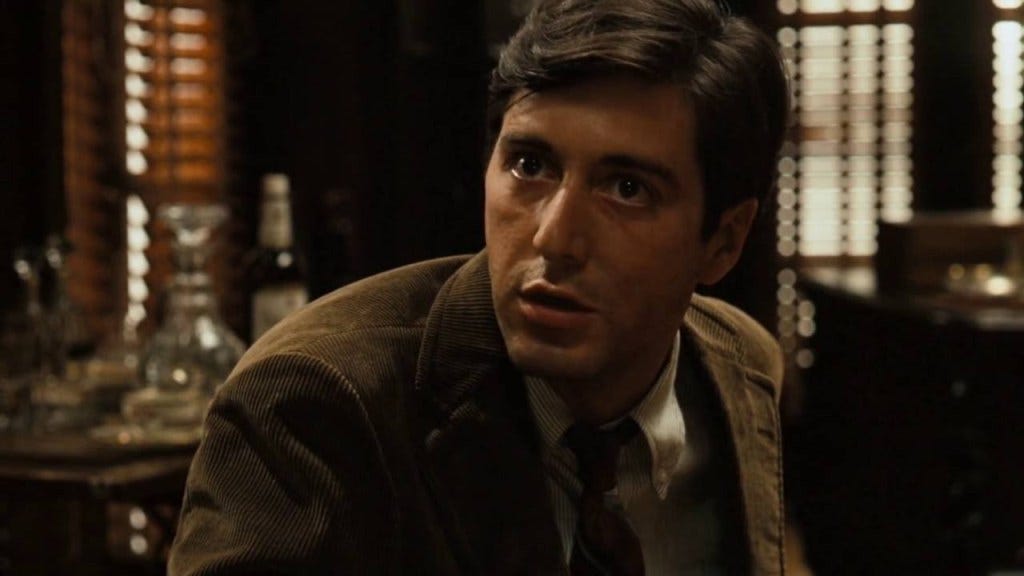
The adjectives ascribed to the character of Michael Corleone are things like cunning, ruthless, remorseless. It goes along with cunning, but I think about a word like savvy when I hear that line. Michael has a sense for what works in the more modern world. The Godfather is a film that touches on many things and addresses different fields--America, morality, masculinity... but there's also a great deal about the old world and the new.
On the one hand, Michael has to head into the old world (Sicily) before he can return and secure his position as the head of the Corleone family. But what also makes Michael so effective as the head of the family is that he can also see the landscape of the present, which becomes clear from early on. It's a small moment, but I believe it reveals a great deal and is aided by Al Pacino's youthfully enthusiastic exclamations. When I think about why a film like The Godfather is so great, and why we can and should talk about film in the same we talk about literature, I think about a small moment like that and just how it reveals something about our character.