
"The Marriage of Figaro"
"Draper? Who knows anything about that guy, no one's ever lifted that rock."

Getting back to my Mad Men re-watch with the third episode of season one, entitled “The Marriage of Figaro.” It’s an important early episode as it really establishes the mystery of Don Draper and lets us know that there’s more to this figure than what’s on the surface.
The Pitch
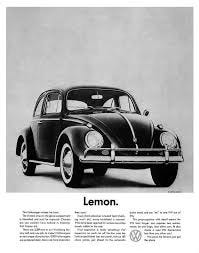
This is a big episode for Don and, specifically, our understanding that there’s more going on to Don than meets the eye. The show opens with Don taking the train into the city, reading the famous VW Beetle advertisement, and running into someone who knows him as Dick Whitman. Our sense of Don is destabilized. Why is he saying that he’s this “Dick Whitman” and why does being identified as Dick Whitman so shake him? As Harry Crane says: “Draper? Who knows anything about that guy? No one’s ever lifted that rock. He could be Batman for all we know.”
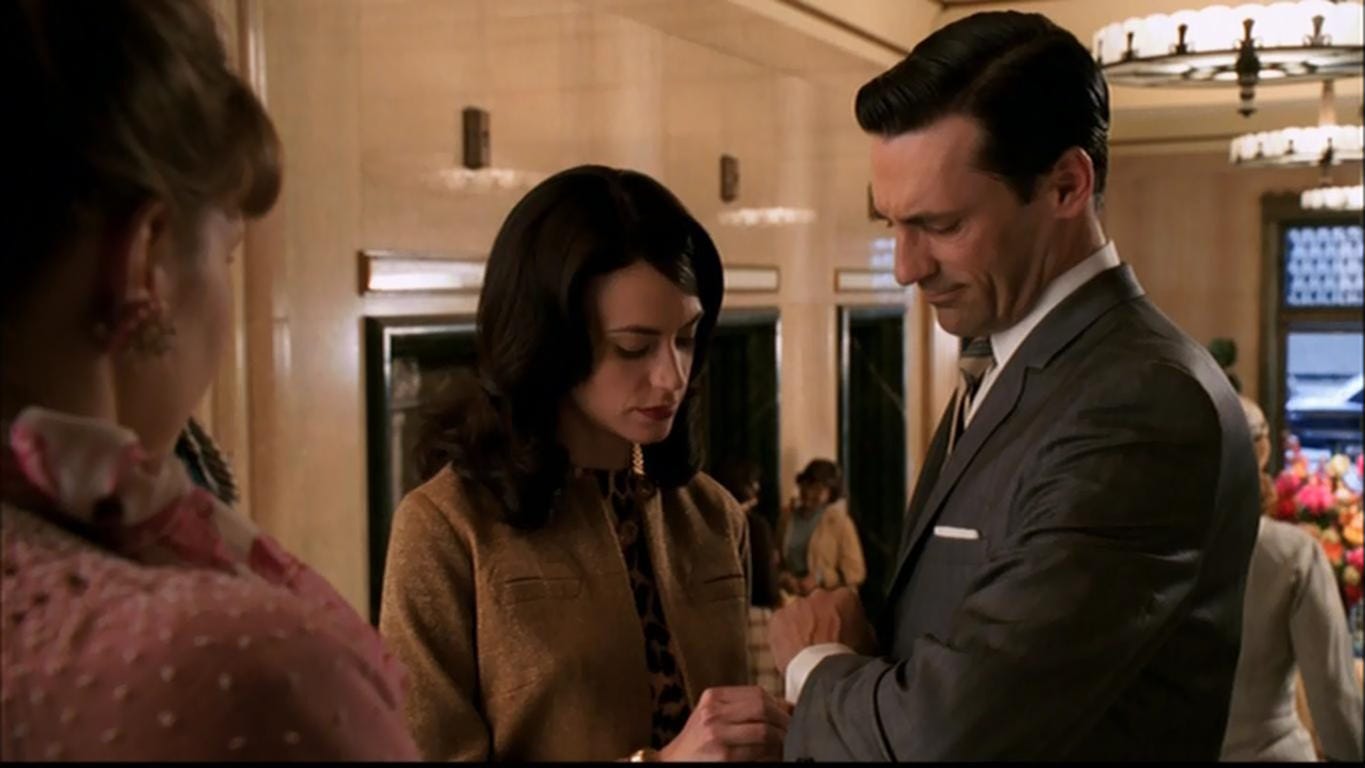
Don’s relationship with Rachel Menken blossoms in “Marriage of Figaro,” from their clear chemistry during the meeting at Sterling-Cooper (as Pete Campbell says, “I’ve never really seen Draper turn that switch on before”) to his eventually kissing her on the roof of Menken’s Department Store with her pushing him away as he reveals that he’s married. There is that clear connection or recognition of something shared in one another, calling back to what Rachel says to Don in the pilot.
When Don and Rachel tour Menken’s Department Store, they stop at one of the display cases and Rachel picks out medieval knight cufflinks for Don, which shows what she thinks of him, some kind of heroic, chivalric figure in the modern age. While Don represents some kind of virtuous all-American ideal to Rachel (as a Jewish woman in mid-century America, the consummate outsider), Don sees something… I don’t know… authentic in Rachel. Some of the early discourse of the show was that Don was secretly a Jewish man and that his desire for Rachel somehow reflected that. I also noted the moment when Rachel, telling Don about her life, mentions that her mother died while she was having her (which happened to Don’s mother too). They both see something of themselves in each other and also something that they want or aspire to.
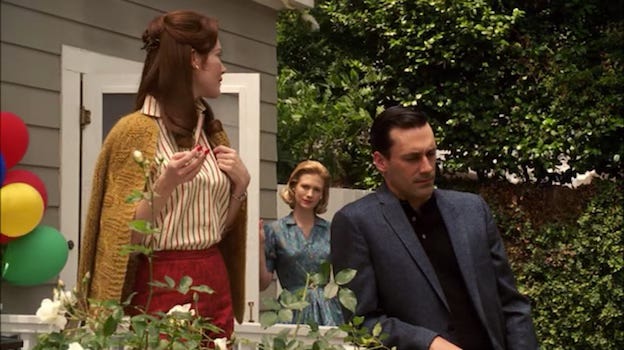
This idea of what we want but then what we’ve been told to want (and the dissatisfaction that emerges because of that divide) comes up at Sally’s birthday party at the Draper home and Don’s obvious dissatisfaction with that domestic world while Betty seems much more at home.
When Carlton, the husband of Francine, says to Don “We got it all, huh?” Don pauses before saying “Yeah, this is it.” The scene where Don films the party highlights some of that dissacoation, as well as the moment that Don sees of the parents of one of Sally’s friends sharing a tender moment.
There’s also the moment when Don, standing outside with Helen Bishop, replies to Helen saying “interesting crowd in there,” referring to all the mothers, with “same crowd out here,” as in the children playing in Sally’s playhouse.
We then see Don, having gone out to pick up Sally’s birthday cake, driving past his house and not stopping, clearly not wanting to return to that world. Later, sitting in his car, smoking, Don smokes as he watches a train pass by. Some speculated that Don was contemplating suicide in that moment—idling by the train tracks. But more than death, he seems drawn to escape, to the romantic freedom of “riding the rails,” a theme that appears prominently starting with ‘The Hobo Code.”
Ultimately, Don does return home with a present for Sally to make up for his absence. Perhaps recalling what Rachel said to him during their meeting—“For a little girl, a dog can be all you need. They protect you, they listen”—Don returns home with a dog for Sally, as Betty retorts “I don’t even know what to say.”
Traffic Meeting
Though she’s been brought up before, and seen as Betty drives past in “Ladies Room,” we have our first episode with Helen Bishop. It’s fascinating to watch how the other mothers, led by Betty and Francine, see her as this kind of oddity or sob story or someone to be mocked. It’s clear how much these women are threatened by or don’t understand Helen and what’s happened in her life (as the show progresses, she becomes a more… negative (?) character, but here she’s clearly to be sympathized with).
Of course, the central irony is that she ends up saving the birthday party with her Sara Lee cake from the freezer when Don doesn’t return. A big part of the first season hinges on the Betty and Helen Bishop dynamic so finally encountering this character is a big moment. I also want to highlight the moment when Carlton offers to help with being a male role model figure for her son, Glen (totally overlooking, as Helen notes, the baby), and how Helen picks up on what Carlton is offering might be more than just throwing the ball around (given that Francine discovers that Carlton has been having an affair, Helen’s concerns were perhaps not so off base).
The 538
Pete Campbell is back from his honeymoon and there to make Peggy feel bad or weird about their night together following Pete’s bachelor party and tossing some back-handed compliments Trudy’s way.
Pete also invites Don and his wife to have dinner with him, which only finally happens in Season 5 (with a different wife).
I always wanted to see more interactions between Don and Helen Bishop as I think here distinctiveness (a divorcee in a time when that was quite notable). I also love how Betty perks up and sends Don to pick up Sally’s birthday cake when she sees Don standing near Helen Bishop. Does she feel threatened by Helen? Worried that Helen would try to steal Don?
I didn’t put it in New Business because it’s not a client of Sterling Cooper, but VW pops up a lot in this episode. I mentioned it earlier, but the famous Volkswagen advertisement by DDB plays an outsized role in the beginning of the episode. I hate to admit Harry does something well, but I enjoyed his point “you’re supposed to say it’s a great car, not a great ad.” Also, Helen Bishop drives a Beetle, perhaps solidifying her modernity.
I love the reference to D.H. Lawrence’s Lady Chatterley’s Lover. Just an allusion, but very much in keeping with the literary bent of the show.
A good line by Rachel, describing Don at her meeting with the other members of their Sterling Cooper team: “Something about the way you talk restores my confidence”
Another great line from Don, “It wasn’t a lie, it was ineptitude with insufficient cover.”
We’ll pick up with further delving into the mystery of “who is Don Draper” and his contentious relationship with Pete Campbell in the next episode, “New Amsterdam.”