
BlacKkKlansman: "Why are you acting like you don't got skin in the game?"
Spike Lee's hit 2018 film starring John David Washington and Adam Driver.

Spike Lee’s 2018 film Blackklansman is yet another film I’d been meaning to watch, but that took me a minute to finally screen. Lee’s film, co-written by Charlie Wachtel, David Rabinowitz, Kevin Willmott and Lee himself, was seen as something of a comeback or reassertion of Lee’s prowess as a filmmaker. It received multiple Academy Award nominations (including Lee’s first Best Director nomination) and Lee and co. won for Best Adapted Screenplay. BlacKkKlansman is smart, timely, well-acted, and politically urgent—but it stops short of fully embracing either cinematic excess or radical confrontation, which leaves it feeling restrained for a Spike Lee “return to form.”
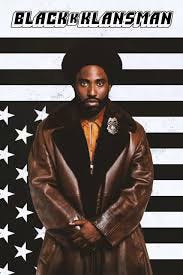
Our Wikipedia synopsis of BlacKkKlansman reads as follows:
Set in the 1970s in Colorado Springs, Colorado, it follows the first African-American detective in the city’s police department as he sets out to infiltrate and expose the local Ku Klux Klan chapter.
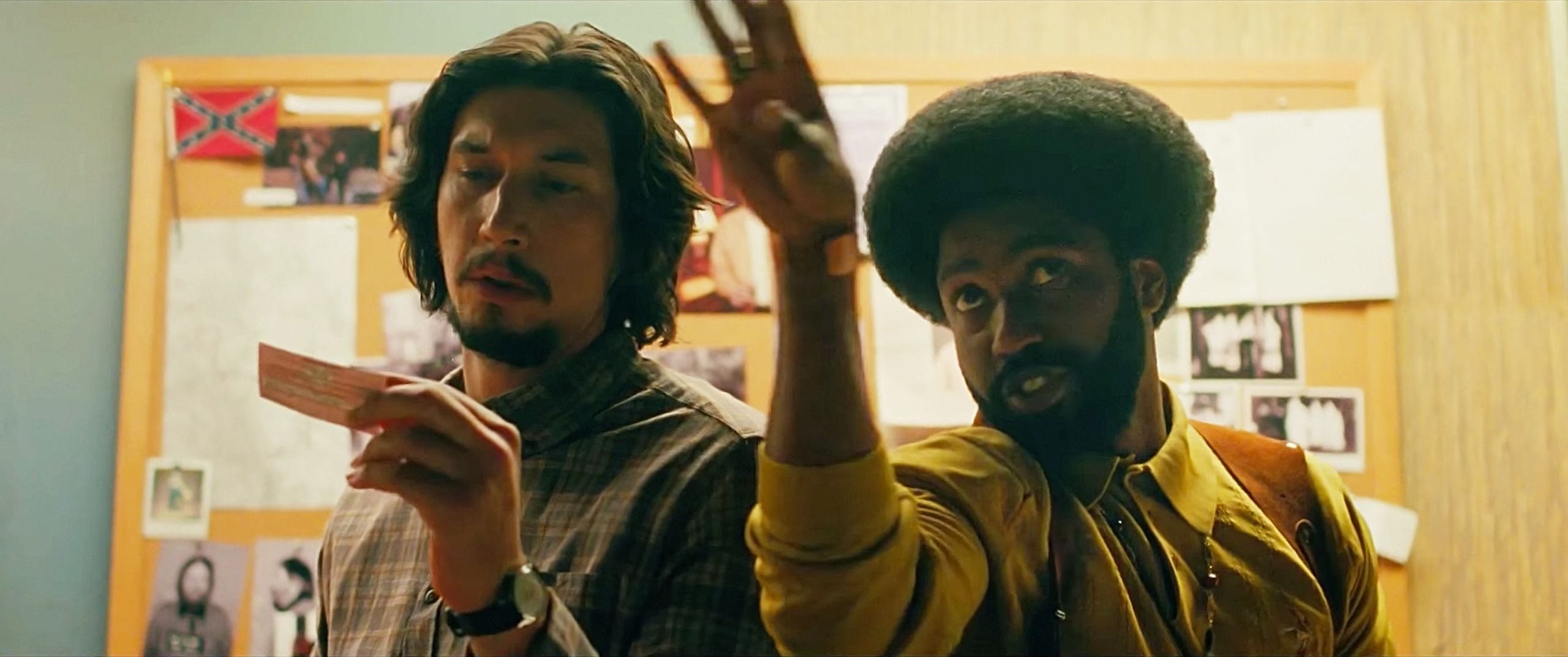
John David Washington plays that African-American detective, Ron Stallworth, while Adam Driver plays his partner, Flip Zimmerman, who does the actual infiltrating and deals with the conflict of being Jewish and having to pretend to fit in with these people. Jasper Pääkkönen plays Felix, the chief antagonist amongst the KKK members. Washington (who I only recently learned is Denzel Washington’s son) does good work playing out the tension of an African American man working on the police force and the contradictions that would emerge from that, particularly in his relationship with Patrice Dumas (played by Laura Harrier). Driver is great as well and he remains a welcome presence in any film he’s in and Pääkkönen is menacing and terrifying in his role.
Topher Grace shines by playing David Duke, Grand Wizard of the KKK. What is both entertaining and notable about Grace’s portrayal is that he plays Duke like this boring, meek office worker or bureaucrat, showing both how present that kind of hatred can be while also… making it look ridiculous (hear this kind of dorky-looking guy talk so much about white power and white supremacy and you realize how full of it Duke and all those people are).
What struck me, and I’ve seen this appear in some of the contemporary reviews, is how Tarantino-esque the film felt. That’s not to say that it doesn’t feel like like a Lee film—it’s not as frenetic and it feels a little bit more in “touch” with the real world as opposed to the cinematic world. Now, Lee does make interesting calls to film with the invocation of Gone With The Wind and Birth of a Nation all feeling quite Tarantino. I also think about the incorporation of historical figures and the turning of a historical narrative into an action/caper/exciting narrative that feels a bit like Tarantino’s latter-day work. I also see wish fulfillment played out on screen too to some degree, though Lee is doing it with a bit more reverence. Lee had been pretty pointed with his critique of Tarantino in Django Unchained, saying “American slavery was not a Sergio Leone spaghetti western. It was a holocaust. My ancestors are slaves. Stolen from Africa. I will honor them.” Zach Vasquez highlights the ways in which this film connects or overlaps with some of Tarantino’s work
Loath as either man would probably be to admit it, BlacKkKlansman would make a hell of a double feature with any of Tarantino’s last three films, but especially his 2009 World War II revenge drama, Inglourious Basterds. Beyond the surface-level similarities of their creatively spelled titles and their plots — both are period pieces centered on the infiltration of white nationalist organizations (German Nazis and the American Klan) by members of the races they oppose (including, in each case, Jews) — they are also both feature-length essays on the history of cinema.
There are some masterful scenes in the film. In particular, the cross cutting between the David Duke KKK induction ceremony and Harry Belefonte playing a witness to a lynching is quite powerful. Lee is also able to really ramp up the tension when Flip, being “Ron” who is trying to infiltrate and get into the KKK, goes to meet with some of the local KKK members. Lee really amps up the sense of paranoia to make you feel what Flip must’ve been feeling in those moments.
Lee is also clearly gesturing towards our contemporary politics by having characters like Duke speak about “mak[ing] America great” and “America first.” Lee also ends the movie with images off the 2017 Unite the Right rally in Charlottesville, Virginia as well as the hit and run attack that killed and injured counter-protesters, part of a speech by David Duke, and comments by President Donald Trump. While that shift felt a bit heavy-handed, I do think being explicit that we’re still living in the world where the ideas of these people who Stallworth infiltrated—violent, hateful people—have a root in certain strains of thought.
While I enjoyed BlacKkKlansman and do think it’s that “return to form” for director Lee, I was left wanting by the end of it. Given that the film took some pretty big liberties with the story (based on the experience of the real Ron Stallworth), Lee could’ve leaned in a bit to playing up the cinematic elements to tell a more… exciting? cinematic? story (this would be the Tarantino way). There were good moments and visuals and strong performances, but it felt like there was still meat on the bone, to use a metaphor. Perhaps it speaks to how high my estimation of Spike Lee and his work is, that I could be saying that after watching such a well-made and engrossing picture, but that was what I was left with at the end of BlacKkKlansman.