
The Odyssey: "Tell me about a complicated man"
Christopher Nolan's adaptation of Homer's epic poem lives up to the hype.

It’s not an overstatement to say that Christopher Nolan’s adaptation of The Odyssey has been one of the most anticipated films in recent memory. You have a director at the level of a Steven Spielberg, making big and exciting movies that are also worthy of robust critical acclaim, adapting one of the great works of world literature. Coming off the enormous triumph of Oppenheimer, very few if any directors were riding as high as Nolan and thus he decided to take on one of the great stories in the history of the world.
I’ve already written a bit about how the film got me thinking about literature and teaching, but I also want to think about it as a film, which is what I’m doing here (though there will certainly be some overlap). What jumped out to me was the way in which Nolan’s adaptation turned the story of Odysseus and his return to Ithaca from Troy into a Christopher Nolan story. And I’m not just talking about visual and cinematic tropes. The film—the camera work, the camera movement, the color palette—looks and feels very much like a Christopher Nolan movie. Here I’m talking more about the content. Nolan has an interest in humanity’s ability to both move forward and do more but at great cost. I don’t have to delve too deep into how this factors into Oppenheimer, and there’s certainly this element to Interstellar (why they are looking for places beyond the Earth), and the idea of escalation within the Batman trilogy (did Batman “create” the Joker?), but we see this in Nolan’s adaptation of The Odyssey through the gambit of the Trojan horse being cast in the same way as the bomb or the idea of Batman.
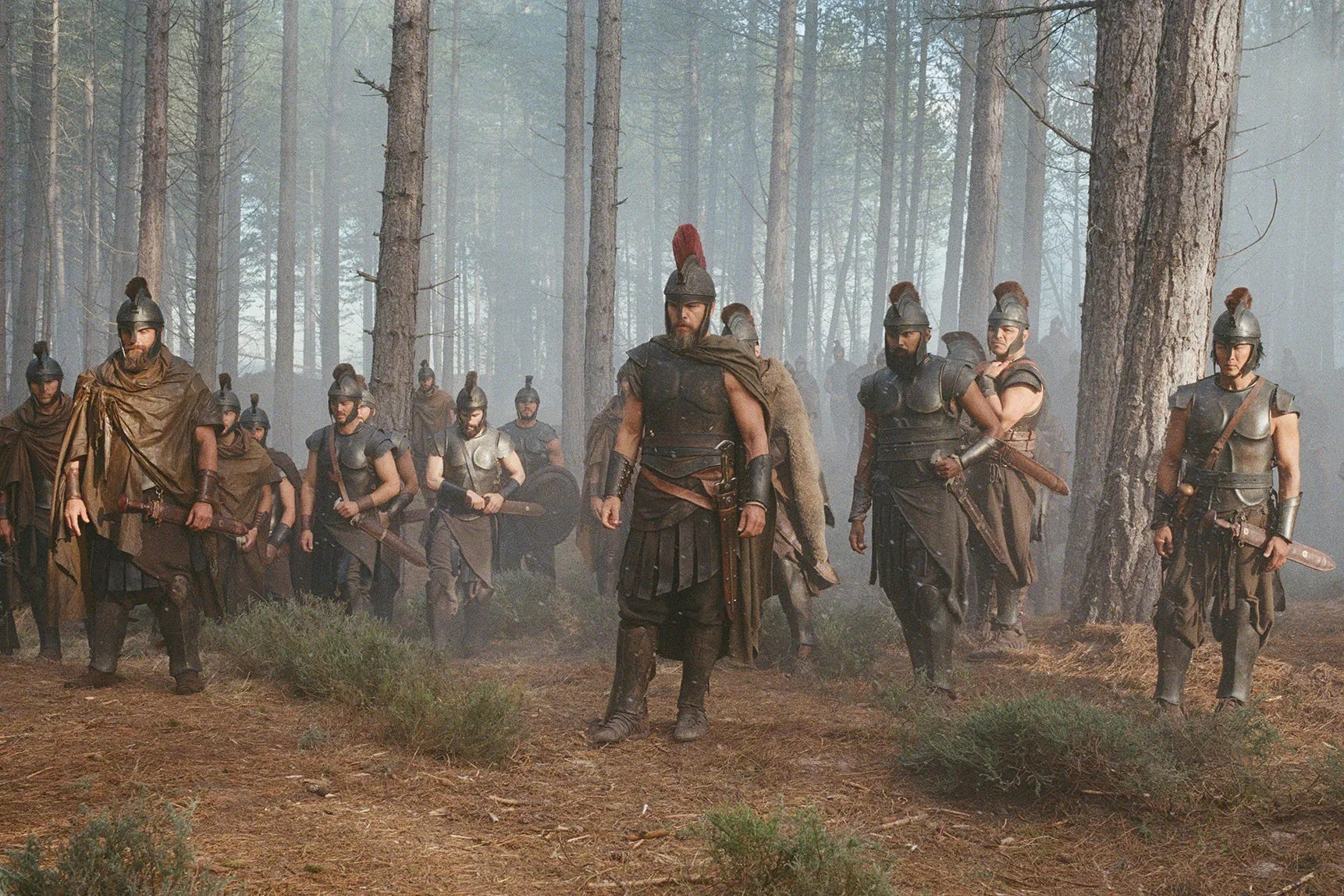
Matt Damon’s portrayal of Odysseus is more in line with Nolan’s protagonists like Batman or J. Robert Oppenheimer—these stoic, serious men who create or do something big but also at a seemingly great cost or effect. I’ll make reference to “Odysseus as Batman” later, but it felt that way. Without getting too much into “well, this is different than the source text” because that’s a difficult thing to say about something like The Odyssey, but Odysseus is not that kind of character. Intelligence, craftiness, and wittiness are all ascribed to him, things that are all somewhat absent from Damon’s portrayal. While it is played up to an almost comic degree in Oh Brother, Where Art Thou, George Clooney’s performance as the Odysseus-esque character Ulysseus Everett McGill seems more in line with this conception of the figure. I don’t think that’s something that diminishes what works about this film, but I do think it’s worth noting. It’s also a director’s prerogative, when adapting something, to filter it through their own lens. That’s particularly resonant when it comes to a text like The Odyssey that has been translated so many times and comes from this oral tradition to begin with. It’s always being filtered through different lenses, and this is no exception.
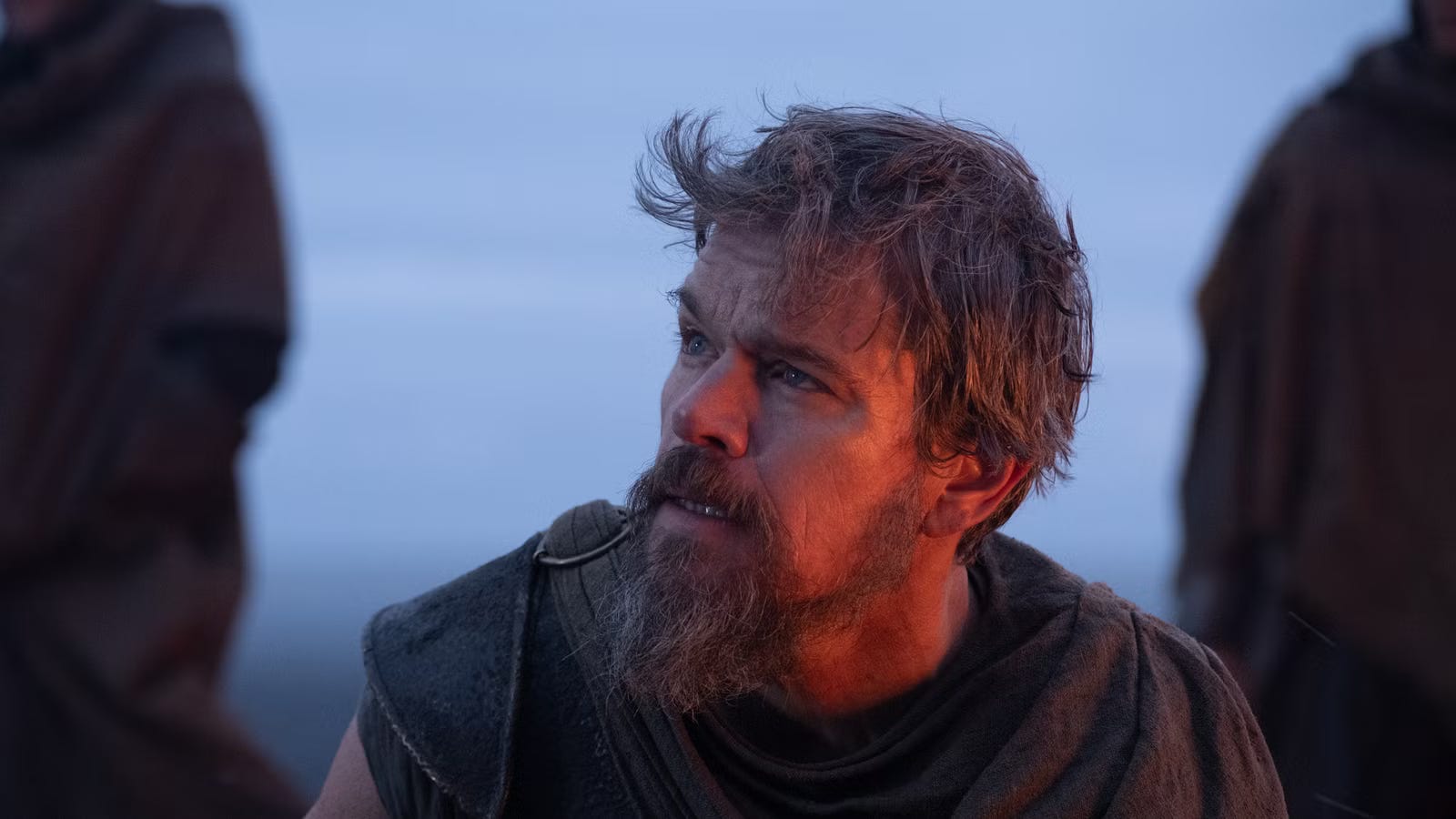
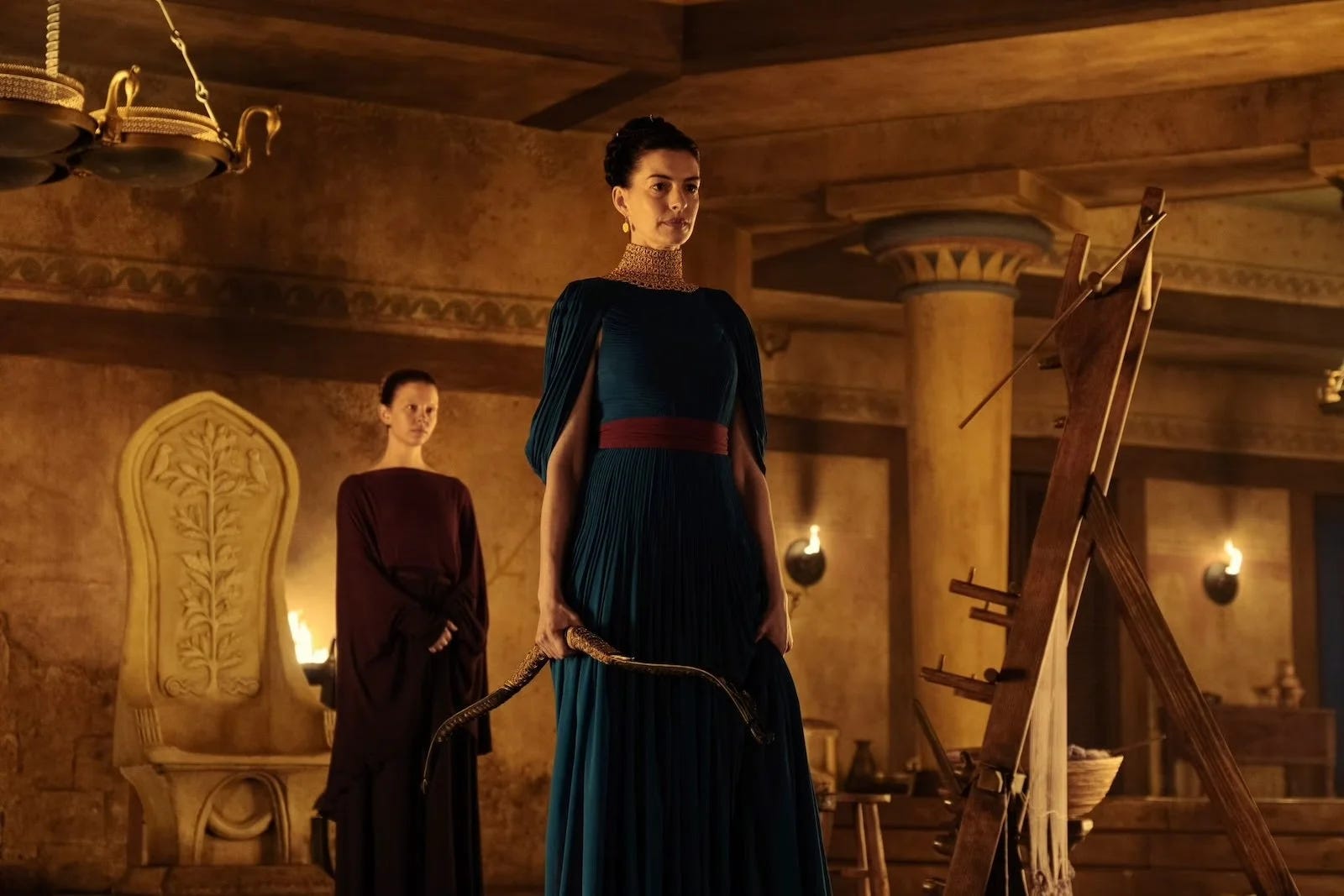
Sometimes the protagonist in a Nolan film is a difficult spot for an actor as those protragonists are usually cyphers or somewhat obstuse. While there’s a bit of that to Damon’s Odysseus, I think he centers the movie and functions as the gravity holding everything in orbit. Anne Hathaway is great as Penelope, while I think Tom Holland handles the tough part of Telemachus (who is perhaps weakened a bit in the adaptation relative to how he appears in the poem) quite ably. I must note Robert Pattinson’s wickedly wonderful performance as the chief suitor after the hand of Penelope, Antinous. It’s a very big and commanding evil performance, and yet I think he does it perfectly. I think he’s probably a lock for a Best Supporting Actor nomination. Zendaya is captivating as Athena, while I of course enjoyed Jon Bernthal’s performance as Menelaus. Charlize Theron is aptly cast as Calypso, while Samantha Morton gives us a new imaging of Circe, yet it is quite powerful and she commands that stretch of the film. Elliot Page was also great in the role of Sinon, helping to provide another emotional manifestation of Odysseus’ guilt while Lupita Nyong’o is great as Helen.
Though not an “action” movie, The Odyssey does giver us some great set-pieces—the fall of Troy, the escape from the Cyclops’ cave, the defeat and expulsion of the suitors from Ithaca, to name a few. The fall of Troy features some stunning visuals and cinematography that I’ll be thinking about for a long time. The final third of the film, with Odysseus reclaiming his home, does feel a bit like something out of a more… conventional movie (this is really where I joked about Odysseus turning into Batman), but it’s also profoundly satisfying and, to use a term associated with Ancient Greek theater, cathartic. There are also other standout scenes that let the performances shine such as the trip to the underworld, and Odysseus’ ship passing by the Sirens with him tied to the mast so he’s able to hear the siren’s song.
In terms of criticisms, I don’t have a ton. There were stretches where the film felt slow (I think it took a little while in the beginning to really get rolling), but that’s perhaps not a surprise given the film is adapting an epic poem that aims to tell this vast and enormous story. It also makes sense given that it creates a yearning in the audience to get closer to “home” in the same way that Odysseus feels something similar. Here, I engage with the idea of Nolan pulling things out to give his adaptation a kind of relevance or connection to the present, which is not something I think is a flaw per se but it was something I noticed and at times suspended my disbelief a bit. Specifically, the casting of Odysseus’ guilt at what he did during the Trojan War (and the move of the Trojan Horse) fits knowing what we do about Nolan’s concerns and interests, but it might not be there in the text (or as much as Nolan would like us to believe) and thus it stands out a bit. I think it helps to connect the dots to our present moment and certainly “works,” but it feels more of the part of the film that is reflecting Nolan’s thematic concerns rather than that of The Odyssey. Nolan’s decision to sideline the Greek gods save for Athena was an interesting choice, and one I might not have made. The cyclops, after being blinded, does cry out to its father in Poseidon and there is mention of the gods, but we don’t see them.
Ultimately, The Odyssey is a success and a second great epic in a row (though of a different time) for Nolan. It might crack my Top 5 Nolan films (I’d put Dark Knight, Batman Begins, and Oppenheimer above it, though I still have a few of the other referred films in his filmography to watch). I think it will be an awards favorite (we must highlight cinematographer Hoyte van Hoytema, editor Jennifer Lame, and composer Ludwig Göransson for their contributions). I also hope it portends a run of our great directors, our major cinematic voices, trying to tackle our classic texts (which will, hopefully, encourage people to return to those texts and read them). Though there were some things that didn’t totally work for me, and this functions as the narrative very much filtered through the lens of Nolan’s thematic and philosophical concerns, The Odyssey works great as a film and should portend even greater successes for Nolan and the film industry.
You can find my writing on sports at Our Nervous Sporadic Games, my writing on music at The Record Sleeve, and my writing on literature and culture and education at Creative Reading