
Dunkirk: "All we did is survive."
A masterclass in cinema and tension courtesy of Christopher Nolan

After watching The Odyssey, I felt compelled to fill in the gaps in my Christopher Nolan film watching. I decided to start with a film that is talked about as perhaps his best work, 2017’s Dunkirk. The film depicts the Dunkirk evacuation in World War II, focusing on one week on the beach, one day in the rescue flotilla, and one hour of the air battle. Dunkirk is an interesting work in Nolan’s oeuvre because it both represents a summation of everything that came before while gesturing towards the kinds of stories and themes he would engage with in his subsequent films.
There’s a degree of propulsion and focus to Dunkirk that feels different from the more languid and contemplative pace that he takes in those two most recent films (Oppenheimer and The Odyssey). The film’s run time is around an hour and forty minutes, his shortest runtime since his first feature film, Following. With that compressed run-time, the tension and anxiety is so compressed that you have this palpable feeling of anxiety and dread that washes over you as the viewer. Lee Smith’s editing and Hans Zimmer’s score both foreground that tension with the cuts being jarring (in a good way) so that you always feel a bit unstable while the music acts like the ticking of the clock.
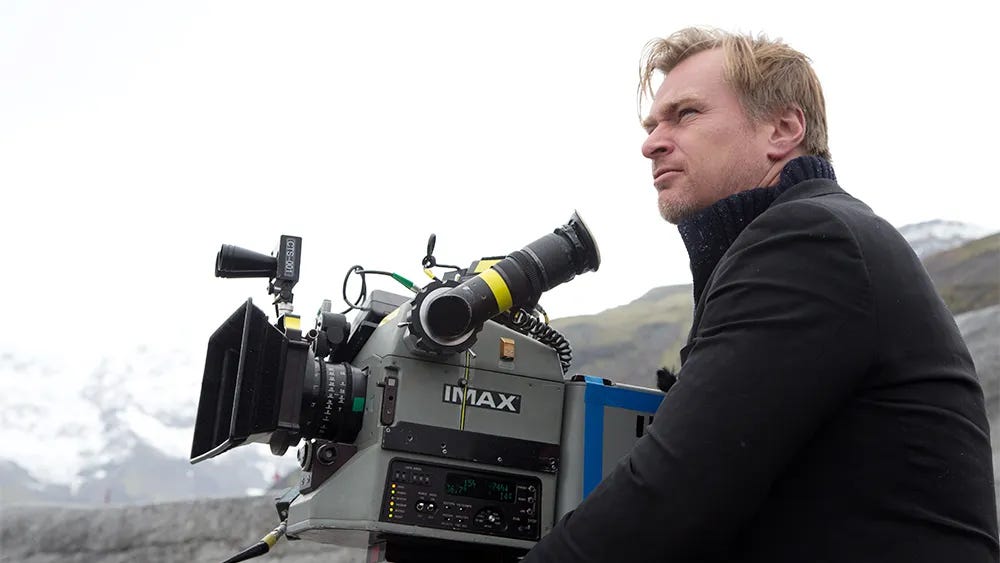
Though there are actors we know in this film (Tom Hardy, Cillian Murphy, Mark Rylance, Kenneth Branagh), the actors themselves aren’t the “stars” of the film, which is in keeping with the wartime setting and the way in which the individual can be lost amidst the chaos and savagery of warfare. As Manohla Dargis describes in her review of the film for The New York Times, “Mr. Nolan instead narrows in on a handful of men who are scrambling and white-knuckling their way into history on the sea, in the air and on the ground.” In a way that does clash with much of his interest in “great men,” this narrative really focuses on the men on the ground, the people oft overlooked but who “make” history.
In a similar way, the dialogue of the film is quite sparse, which is quite surprising for a director (in)famous for exposition dumps in his scripts. But the words don’t “matter” in the same way that everything happening around the characters (the setting and sounds of war) matter.
The fragmenting and play with time feels very much out of Inception, and I think how Nolan has played with time makes sense relative to how that time would’ve felt to those experiencing it. Again, from Dargis’ review, “Mr. Nolan’s elastic approach to narrative works beautifully[…] the dividing lines aren’t always obvious as Mr. Nolan cuts from daytime scenes on the ground to those in the sea and in the air, a slight merging of space and especially of time that underlines the enormity of a fight seemingly without end.” Though that lack of clarity in chronology (when certain events are occurring) is frustrating, I do believe it makes sense given the story that he’s telling, and even some of that confusion might be what he wants us, at the audience, to experience. One cannot help but look at the work of cinematographer Hoyte van Hoytema and note the scenes on the beach at Dunkirk or at sea, and not see echoes later in The Odyssey.
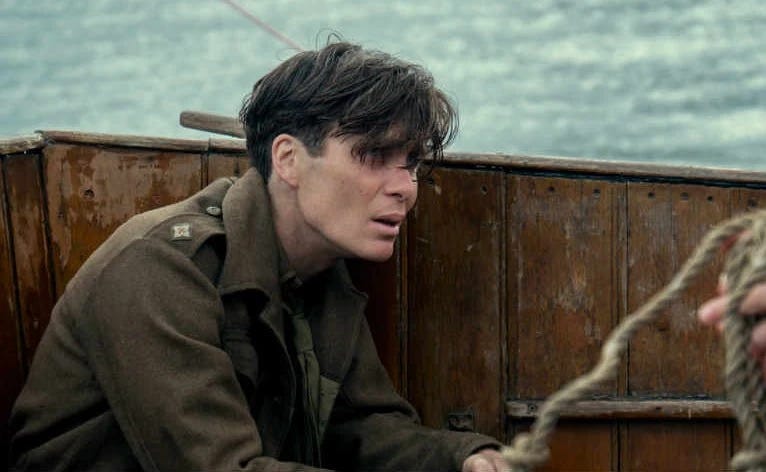
I mentioned this is a film that places the actors in the proverbial background relative to the enormity of the story itself, but that does not mean that the performances were not notable. I think particularly of Cillian Murphy’s character, identified only as “Shivering Soldier,” depicting someone in a state of trauma described by Rylance’s character as “shell-shocked [...] He’s not himself. He might never be himself again.” Tom Hardy’s Spitfire pilot, Farrier, perhaps occupies some of the heroic, "great man” space we associate frequently with Nolan and his work, but he’s sidelined in a way, obscured by a flight mask, that makes it all feel a bit different. The actors given the most focus and “face time” are not the “big names.”1
Dunkirk is a film I didn’t quite know what to do with, and one that I feel like I will appreciate much more when I go back and rewatch. It’s obviously not trying to be a fun and exciting war-time action-adventure movie like Inglorious Basterds or even something like Saving Private Ryan (which shows both the hellish nature of war while also showing the virtue in the men who have been called in to carry it out). I think it’s something of a wonder of the form of cinema and what can be done with this art form, almost making me think of Vladimir Nabokov’s writing and the way in which the form of it was so perfect and had this command of craft. Matt Zoller Seitz makes an apt comparison in his review of the film, writing how Nolan was “like a more restless cousin of Terrence Malick, who infused the combat picture with Transcendental philosophy in The Thin Red Line.” That sense of appreciating but also feeling as though I didn’t fully grasp that I had with The Thin Red Line was certainly there with this film as well. But I think about Dargis’ exhortation that the film is “a tour de force of cinematic craft and technique.” Sometimes making that claim can be seen as a dismissal, but with Dunkirk I think it’s a testament to its quality.
You can find my writing on sports at Our Nervous Sporadic Games, my writing on music at The Record Sleeve, and my writing on literature and culture and education at Creative Reading
Of course, Harry Styles is exceptionally well-known though not as an actor.