
Moneyball: "It's hard not to be romantic about baseball"
Thinking about the difference between accuracy and authenticity, and what happens when you know what "really" happened in a film.

I’ve posted this over at my baseball-centric newsletter, Our Nervous, Sporadic Games. If you haven’t, please consider subscribing and share widely!
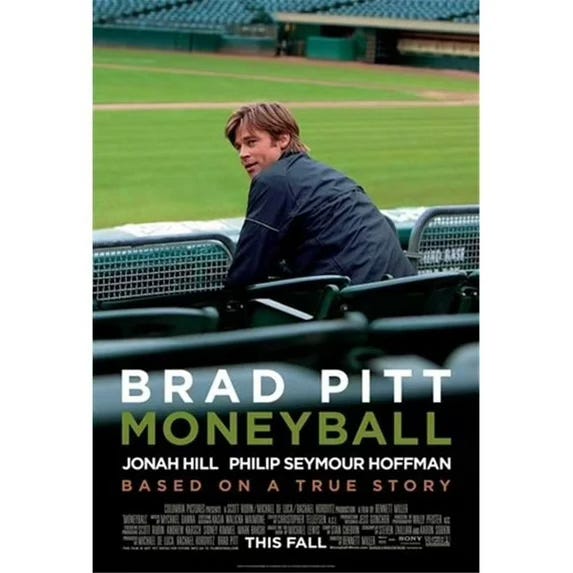
I was in a moment where, rather than watching something new, I needed to go back to a film I’d watched before. I elected to go with 2011’s Moneyball, directed by Bennett Miller and starring Brad Pitt and co-starring Jonah Hill and Chris Pratt.
Our IMDB summary of the film is as follows:
Oakland A’s general manager Billy Beane’s successful attempt to assemble a baseball team on a lean budget by employing computer-generated analysis to acquire new players.
Though I’d make jokes about it with others in the past, this was the first time watching Moneyball that I couldn’t help but think about how what was depicted (or the drama) was not what “actually” happened.
How do I know? Well, of course, I was there. This whole story was set when I was a junior in high school, probably at my peak of watching and caring about baseball. I was at games during the season depicted, and I remember what happened and can tell the difference between what actually happened and what is depicted in the film.
The question I find myself really reckoning with—what level of invention and eliding and synthesis am I willing to overlook in the name of a good narrative when I’m quite familiar with a given subject. Or, in short, what is the difference between accuracy and authenticity (or truth)?
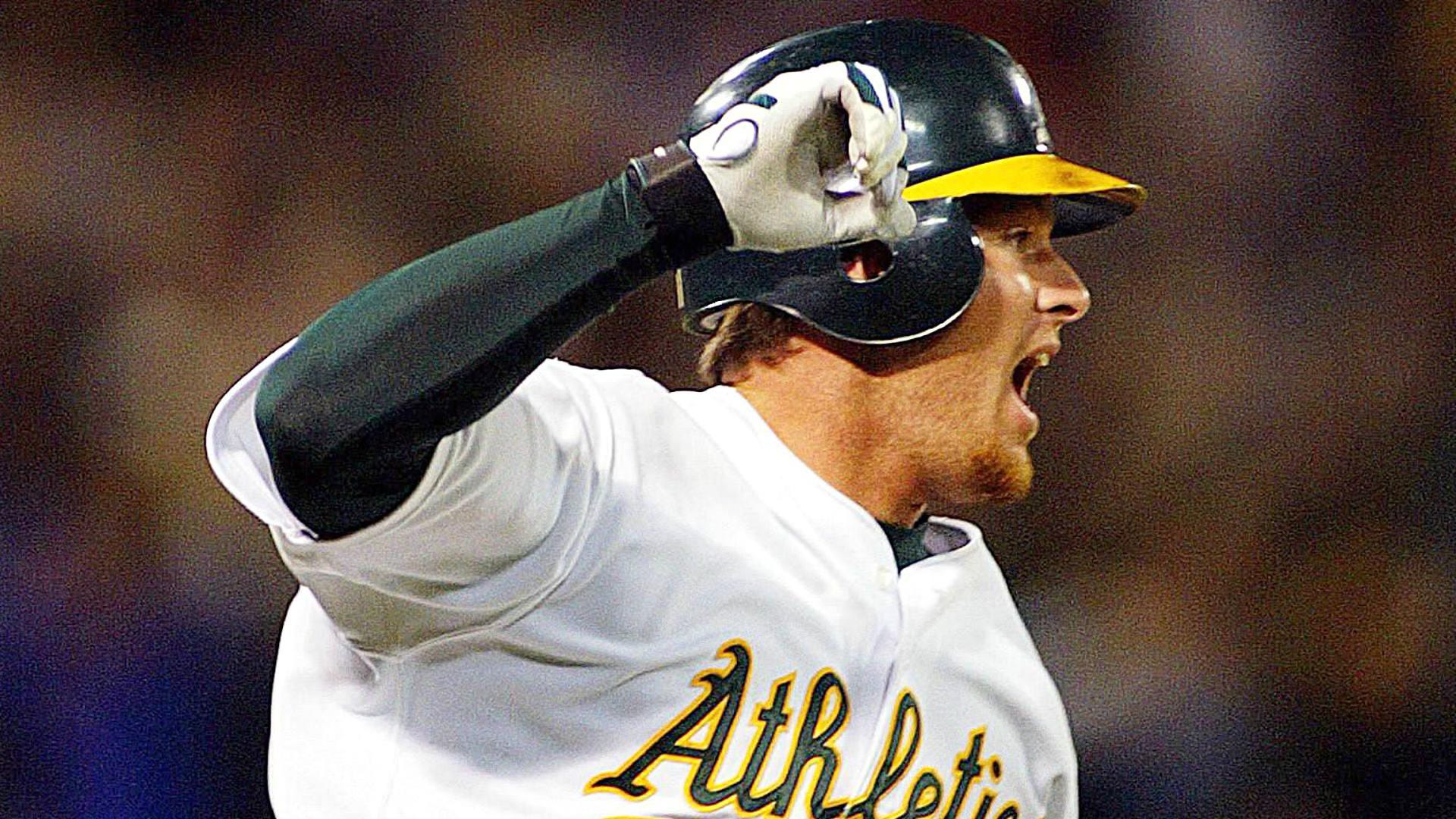
To be certain, there are things in Moneyball that are accurate and true. There was the big organizational concern about how to replace the lost production of Jason Giambi, the signing of Scott Hatteberg and his conversion to first base (also, the “picking machine” line), the A’s slow start to the season and the surge later on, the 20 game winning streak, the methods of Billy Beane as a GM and how he wanted to evaluate players and construct a roster in a way that challenged many assumptions and orthodoxy in Major League Baseball, the ways in which the Oakland ownership was quite unwilling to invest money into the club.
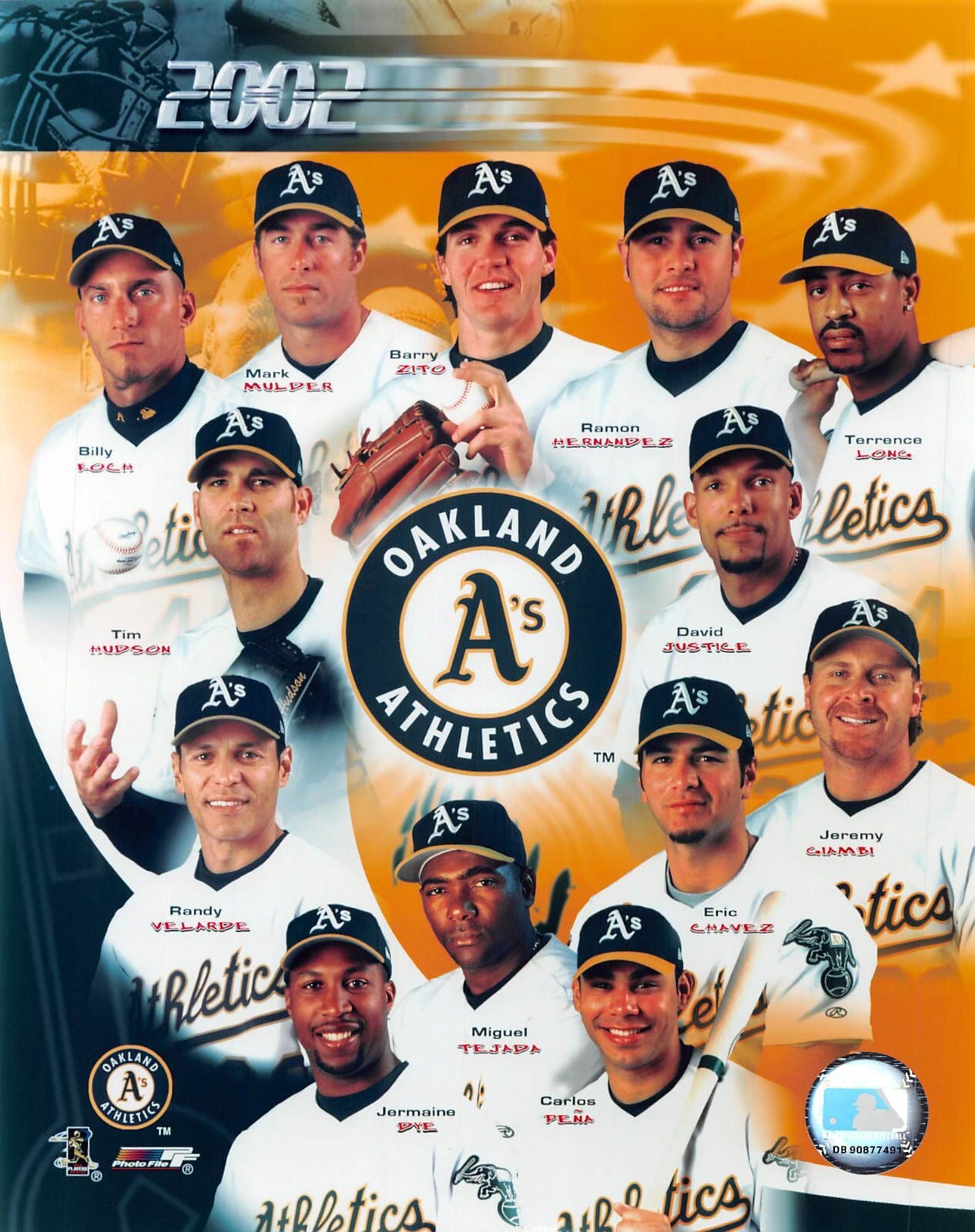
What did Moneyball forget or get “wrong,” as it were? There’s no mention of Cy Young winner Barry Zito and MVP Miguel Tejada (as well as pitchers Tim Hudson and Mark Mulder and third baseman Eric Chavez), Jeremy Giambi was already on the team (famously, not sliding in 2001 ALDS Game 3 against the Yankees), much of the depiction of manager Art Howe and the conflict over Hatteberg and Carlos Pena (like… most of the Hatteberg stuff in the film qualifies), what prompted the A’s rise in the standings, a lot of the Chad Bradford stuff… basically everything that makes up the plot and dramatic tension of the film.
For the first time in my many viewings of Moneyball, I found myself getting frustrated knowing all this, and I found myself wrestling with what does one do when they know and remember the events that a work of art (film, novel, tv show, whatever) is based on? There are certainly higher stakes examples of this—All the President’s Men and JFKaddress much bigger things—but this is the one that’s closest to my own experience. What do you do when you know (as best as one who wasn’t actually participating in it) what happened? When the history being turned into narrative was something you lived through?
This, in turn, gets us into a larger question about adaptation and what the goal is for an adaptation of one narrative in one media form into another. What are you trying to accomplish when you take a nonfiction book and adapt it into a film (and, importantly, not a documentary)? While Moneyball certainly takes liberties with what “actually” happened in the name of drama, the story it’s aiming to tell about how Billy Beane was forced to radically change the approach he took in terms of player evaluation to account for the financial limitations associated with the Athletics.
Sidebar: Both in the film and throughout the baseball discourse, Oakland is referred to as a “small market” team, which is hilarious given that Oakland and the East Bay (not even considering it as an adjacent of San Francisco) is a major market. It is not a “small market,” though it is (or was) a frugal organization.
That kernel, that idea, that clearly comes through in the film adaptation and it is, essentially, true. This is how Billy Beane and co. had to think and approach the game in order to compete. As Billy says, “if we try to play like the Yankees in here, we will lose to the Yankees out there.” Those tactics proved to be so successful (even though it did not result in playoff success for the A’s themselves) to the point where the Boston Red Sox built their curse-breaking 2004 team on many of the ideas that Beane stressed.
We then come back to that question of what matters: accuracy or truth? The film is, in many places, inaccurate. Yet, it is also profoundly true. Do those discrepancies matter? If we’re assuming the film is a documentary, then yes. But it’s not. If we’re treating it as an invented work in some essential way (certainly not fiction, but not strictly non-fiction either) with the important point to be the way in which conventional thinking was challenged and a new methodology was introduced? Then those discrepancies don’t matter because that idea is clearly communicated in the film. So while those of us who remember the 2002 baseball season, and the A’s season in particular, might get frustrated or roll our eyes at the way in which Hatteberg’s season is overly dramatized and centralized, it does communicate in broad strokes (in a relatively short amount of time) was was special about Billy Beane, those A’s teams, and their approach to baseball. Therefore, Moneyballis a film that’s worth watching and returning to both for its entertainment value and what it illuminates.